- Ergonomic
- Home Working
- In the Workplace
The Definitive UK Standing Desk Guide: Evidence, Ergonomics and Cost
Introduction
The modern British workplace has quietly become one of the most sedentary in Europe.
With millions of UK employees now working eight or more hours a day at screens—often from home as well as the office—long periods of sitting have been linked to rising levels of back pain, metabolic disease and work-related musculoskeletal disorders.
The NHS and UK regulators increasingly recognise prolonged sitting as a workplace health risk, not just a comfort issue, which is why many employers are now re-evaluating how desks are designed and supplied.
This guide has been written specifically for UK buyers, using standing desk benefits UK data and sit-stand desk health research drawn from British and European sources.
Rather than marketing hype, it focuses on what actually improves health, productivity and long-term comfort for UK workers in 2026, whether you are fitting out a home office, a shared workspace or a large commercial floor.
Why Choose a Standing Desk?
In the UK, standing desks are no longer a niche wellness product; they are becoming a practical response to a genuine public health problem.
British workers spend more time seated than most of their European counterparts, driven by computer-based roles, long commutes and increasingly remote work.
At the same time, UK employers face stricter obligations under health and safety law to prevent musculoskeletal injuries. Understanding how sit-stand desks fit into this context helps buyers make decisions based on evidence rather than trends.
The British Workplace Health Problem (Sitting & Sedentary Work)
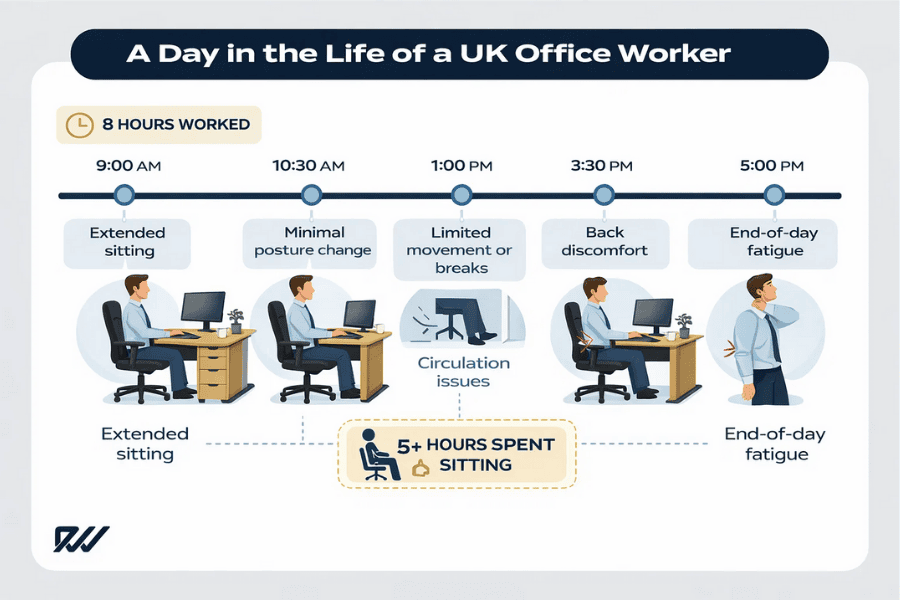
A day in the life of a UK office worker and the impact of prolonged sitting.
The average UK office worker now sits for more than seven hours per working day, often without meaningful breaks.
This level of sedentary behaviour is strongly associated with lower-back pain, neck and shoulder disorders, poor circulation and increased risk of type 2 diabetes and cardiovascular disease.
In Britain, musculoskeletal disorders remain one of the leading causes of work-related illness and sickness absence, costing employers billions each year in lost productivity.
Remote and hybrid working have intensified the problem. Many home workers use dining tables, sofas or poorly adjusted desks, creating awkward postures that load the spine and hips.
Unlike in traditional offices, there is often no professional workstation assessment, so poor habits persist for years. Standing desks do not magically eliminate these risks, but they give workers a way to change posture frequently, which is the key factor in reducing strain.
In a UK context where long hours and high screen time are the norm, the ability to alternate between sitting and standing has become a meaningful ergonomic intervention rather than a lifestyle accessory.
NHS & HSE Guidance on Prolonged Sitting
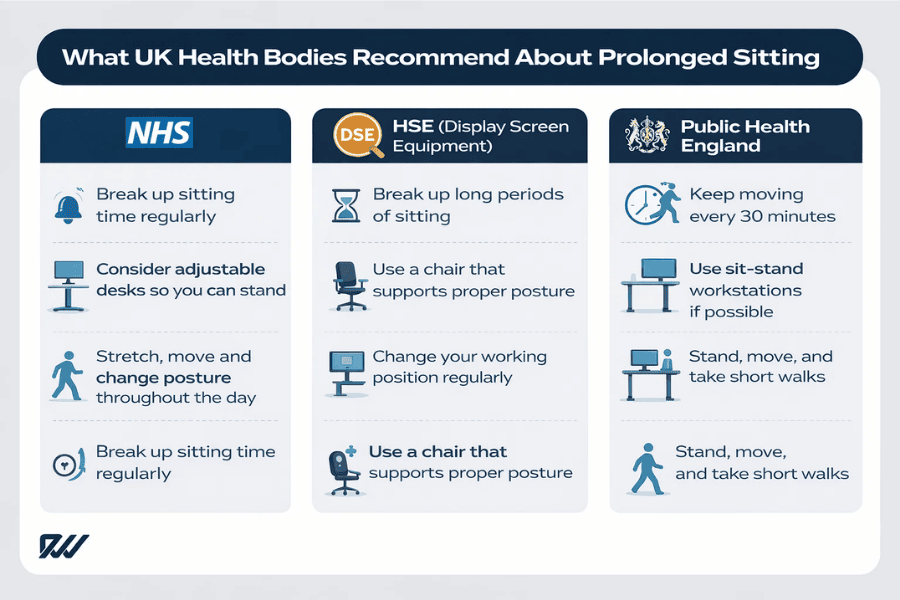
What UK health bodies recommend about prolonged sitting at work.
The NHS and the Health and Safety Executive (HSE) both emphasise that prolonged static posture—whether sitting or standing—is harmful.
UK Display Screen Equipment (DSE) regulations require employers to assess workstation ergonomics and minimise risks from poor posture and repetitive strain. This includes providing adjustable furniture when necessary.
While the law does not mandate standing desks, it does require that employees can work in neutral, supported positions and change posture throughout the day.
Public Health England and the NHS also advise adults to “break up long periods of sitting with light activity”, particularly for people in desk-based jobs.
Sit-stand desks directly support this guidance by making it easy to stand for calls, emails or short tasks without leaving the workstation.
In many UK organisations, occupational health teams now recommend height-adjustable desks for workers with back pain, sciatica or repetitive strain injuries as part of a broader ergonomic strategy.
What UK & European Research Says About Standing Desks
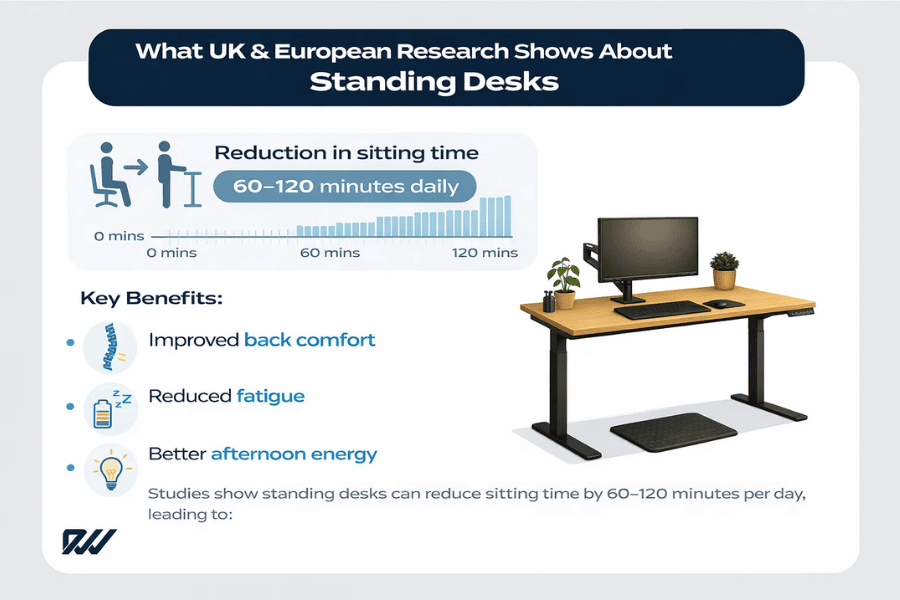
What UK and European research shows about standing desks and their benefits.
Research from UK universities and European occupational health bodies consistently shows that sit-stand desks reduce daily sitting time by between 60 and 120 minutes.
Studies conducted in NHS offices and British local authorities have found improvements in lower-back comfort, reduced fatigue and better perceived energy levels when workers are able to change posture freely.
Crucially, the evidence does not suggest that standing all day is beneficial. Instead, the strongest health outcomes are linked to alternating positions. Regular posture changes improve blood flow, reduce spinal disc compression and decrease muscle stiffness.
Some UK trials have also reported modest improvements in concentration and task engagement, particularly in the afternoon when sedentary fatigue normally peaks. While standing desks are not a cure-all, they are one of the few workstation changes with a solid evidence base in British and European occupational health research.
Standing vs Sitting — What’s Better for Office Workers?
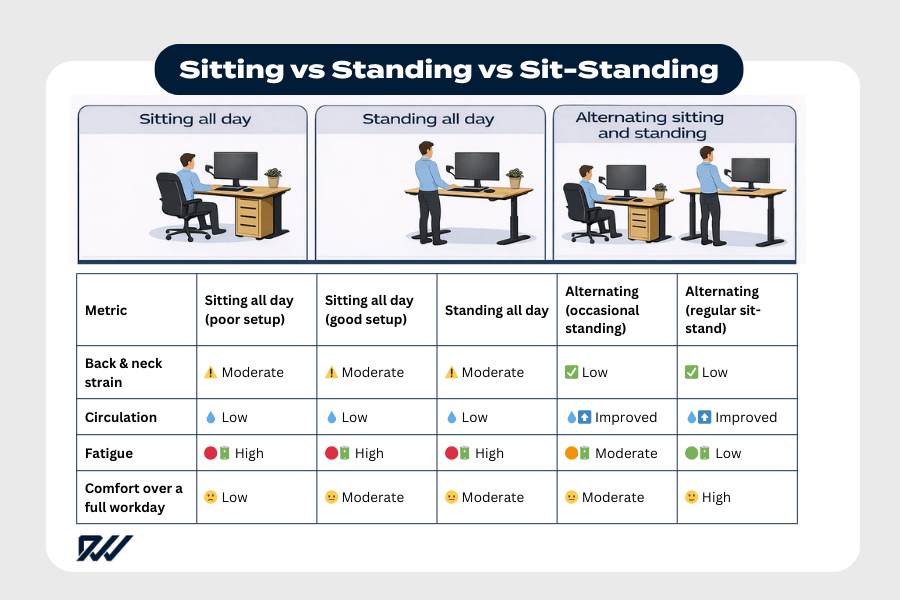
Sitting vs standing vs sit-standing: how different working styles affect comfort and fatigue.
For UK office workers, the real choice is not standing versus sitting, but movement versus static posture.
Sitting for hours in a fixed position places sustained pressure on the lumbar spine, hips and shoulders, especially when using laptops or poorly positioned monitors. Standing continuously can be just as problematic, leading to leg fatigue and foot discomfort.
Sit-stand desks allow workers to shift between these positions based on task and comfort. Typing a long report may be easier while seated, while reading, phone calls or virtual meetings are often better done standing.
In UK workplaces where employees are expected to remain at their desks for long periods, this flexibility reduces cumulative strain. Over a full working week, even small posture changes can significantly lower the mechanical load placed on joints and muscles.
Productivity, Back Pain & Energy Levels — What Workers Experience
Surveys of UK office staff who use height-adjustable desks consistently report lower levels of lower-back pain and stiffness, particularly among people who previously worked at fixed desks. Many also describe improved afternoon alertness and fewer headaches, likely due to better circulation and reduced muscular tension.
Productivity effects are usually neutral to positive. While standing does not make someone type faster, it often helps people stay mentally engaged, especially during routine tasks. Employers in the UK public and private sectors have reported fewer discomfort-related breaks and reduced DSE complaints after introducing sit-stand desks.
The main benefit is not speed, but sustainability: workers who are more comfortable can maintain focus for longer without needing to stop due to pain or fatigue.
| Factor | Sitting All Day | Standing All Day | Sit-Stand Desk |
| Back & neck strain | High | Moderate | Low |
| Circulation | Poor | Better | Best |
| Fatigue | Mental & physical | Physical | Lower overall |
| Productivity | Often drops late day | Variable | More consistent |
Types of Standing Desks (UK Buyer’s Guide)
The UK market offers everything from £200 desktop converters to £2,000 commercial workstations. Understanding the different types of standing desks helps buyers choose something that fits their space, workload and budget without paying for unnecessary features.
Fixed Height Standing Desks — Are They Worth It?
Fixed height standing desks are simple tables designed for use only in a standing position. In the UK they are often found in shared spaces, schools and industrial settings.
Their main advantage is cost: they are cheaper and mechanically simpler than adjustable desks. However, because they cannot be lowered, they are only suitable for people who plan to stand almost all the time.
For most office workers this is impractical. UK ergonomic guidance stresses the importance of posture variation, and a fixed height desk removes that option.
They also create accessibility issues, as a desk set for a 6’2” person will be unusable for someone who is 5’4”. For home offices and modern workplaces, fixed standing desks are usually a poor long-term investment unless used as part of a mixed-desk environment.
Standing Desk Converters
Desk converters sit on top of an existing desk and raise the keyboard and monitor to standing height. They are popular in the UK for renters and hot-desk environments because they require no installation and cost far less than a full sit-stand desk.
Their main limitation is space and stability. Most converters reduce usable desk depth and can feel cramped, especially with dual monitors or large keyboards.
They also have lower weight limits, making them less suitable for heavier office equipment. For occasional standing and small home offices they can be effective, but they are not a substitute for a proper adjustable desk in a full-time workstation.
Manual / Crank Standing Desks — Pros, Cons & Cost
Manual standing desks use a hand crank or pneumatic system to change height. In the UK they typically cost between £300 and £700, making them an affordable entry point into sit-stand working. They are mechanically simple and often very durable.
The downside is convenience. Adjusting the height takes effort and time, which discourages frequent posture changes. In busy office environments, many users simply leave them at one height. For people who only plan to adjust their desk once or twice a day, manual desks can be good value, but they are less suited to dynamic, shared or high-use workplaces.
Electric Standing Desks — How They Work & Typical UK Prices (£)
Electric standing desks use one or more motors to raise and lower the desktop at the touch of a button. Most modern UK models include memory keypads, allowing users to store sitting and standing heights.
Prices typically range from £400 for basic single-motor desks to £1,500 or more for heavy-duty, dual-motor frames.
These desks are the most practical for daily use because they make frequent adjustments effortless. They also tend to be more stable and better engineered.
For anyone working full-time at a desk, electric models offer the best balance of convenience, ergonomics and long-term usability.
Commercial vs Home-Office Standing Desks
Commercial-grade desks are designed for shared offices, call centres and corporate environments. They have stronger frames, higher weight capacities and longer warranties. Home-office desks are lighter and cheaper but may wobble at standing height or wear out more quickly under heavy use.
In the UK, employers fitting out offices should prioritise commercial models to meet health and safety obligations and reduce maintenance. Home users can often save money with lighter designs, provided they match their equipment and usage.
How to Choose the Right Standing Desk
British homes, body sizes and budgets vary widely, so the “best” standing desk is always relative. The key is matching the desk’s physical and technical specifications to how and where it will be used.
Size & Workspace Requirements for Homes & Offices
UK homes often have smaller rooms than those in North America, so desk footprint matters. A typical electric standing desk ranges from 120–160 cm wide. For compact flats or box rooms, 120–140 cm is usually sufficient for a laptop and one or two monitors. Offices with larger floorplates can accommodate wider desks, which offer better stability and more working space.
Depth is equally important. At least 60–70 cm is needed to position monitors at a healthy viewing distance, which is essential under DSE guidance.
Height Range & User Heights (5’2” to 6’4”)
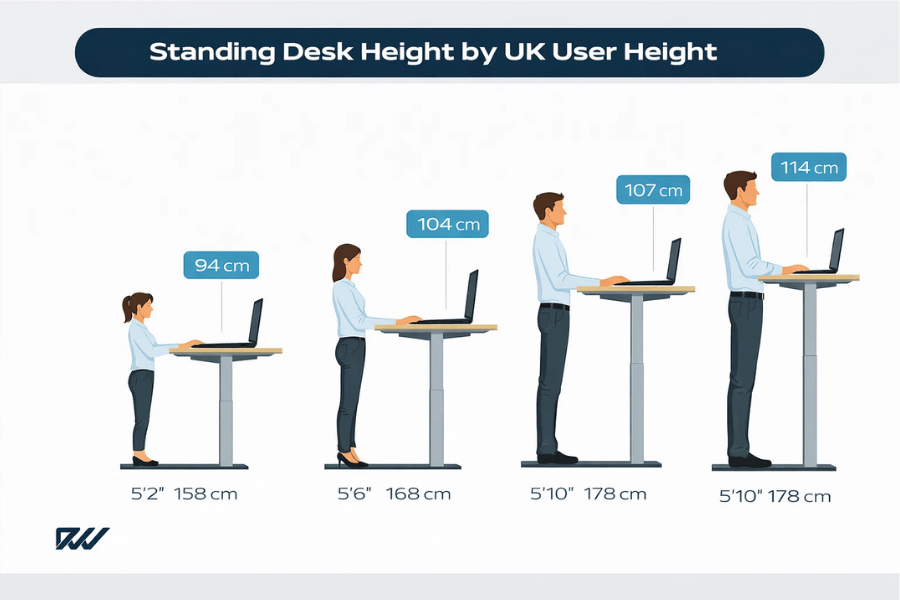
Standing desk height guide by UK user height.
A standing desk must go low enough for shorter users and high enough for tall ones. In the UK, a good electric desk should adjust from around 60 cm to at least 125 cm. This range comfortably covers users from about 5’2” to 6’4”, allowing both seated and standing positions to be set ergonomically.
Desks with limited height ranges force users into awkward postures, undermining the health benefits.
Weight Capacity (Dual Monitors, PCs & Office Gear)
Many UK workers use dual monitors, docking stations and desktop PCs. A desk should support at least 80–100 kg to remain stable and safe. Commercial desks often exceed 120 kg, which is useful for heavy setups or shared use.
Stability & Frame Strength (Commercial-Grade vs Budget)
Wobble at standing height is one of the most common complaints with cheaper desks. Strong steel frames, cross-bars and dual-motor systems improve rigidity. For typing-intensive work, stability is not a luxury; it directly affects comfort and accuracy.
Motor Quality, Noise & Warranty
Quiet motors matter in open-plan UK offices and home environments. Look for desks rated below 50 dB with at least a 5-year warranty. UK-based suppliers also make servicing and parts replacement easier.
Cable Management, Memory Keypads & Smart Controls
Memory keypads allow instant switching between sitting and standing. Integrated cable trays and grommets keep workstations tidy and compliant with safety standards.
| Feature | Budget Desk | Mid-Range | Commercial |
| Height range | Limited | Wide | Very wide |
| Stability | Moderate | Good | Excellent |
| Warranty | 1–2 years | 3–5 years | 5–10 years |
Recommended Standing Desk Options
These recommendations are based on UK availability, overall build quality, manufacturer warranty, and practical suitability for British homes and workplaces, rather than simple brand popularity or marketing presence.
Best Budget Standing Desks in the UK (Under £400)
Typically manual crank or entry-level electric models, these desks are best suited to light home use, student setups, or occasional standing rather than all-day operation.
Best Mid-Range Standing Desks (£400–£1,000)
Well-built dual-motor electric desks offering good stability, smoother height adjustment, and stronger frames. Ideal for full-time home offices, freelancers, and small office environments where reliability matters.
Best Premium & Commercial-Grade Desks (£1,000+)
Designed for demanding use, these desks feature heavy-duty frames, long warranties, and high weight capacities, making them suitable for corporate offices, studios, and professional workspaces.
Best Standing Desk for Home Offices
Mid-range electric desks with compact footprints, quiet motors, and clean aesthetics, making them easy to integrate into spare rooms or dedicated home office spaces.
Best Standing Desk for Corporate & Shared Offices
Commercial-grade models with robust construction, wide height adjustment ranges, and strong after-sales support, well suited to shared desks and long-term workplace use.
Best Heavy-Duty Standing Desk for Multiple Monitors
Premium desks rated over 120 kg with reinforced frames.
| Category | Typical Price | Best Use |
| Budget | £300–£400 | Light home use |
| Mid-range | £400–£1,000 | Daily home & office |
| Premium | £1,000+ | Corporate & heavy setups |
Standing Desk Setup & Height Guide
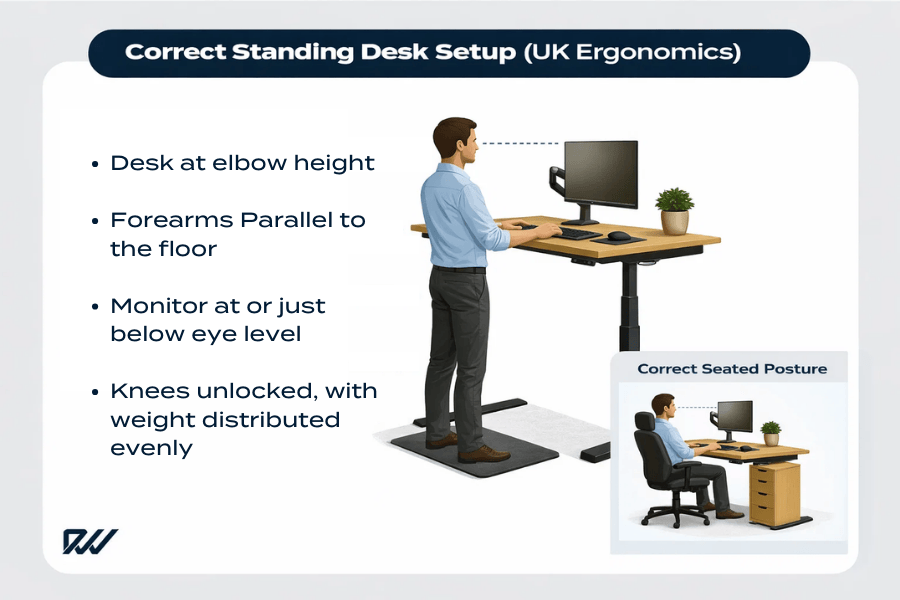
Correct standing desk setup following UK ergonomics guidance.
Even the best desk can cause pain if it is set up incorrectly. UK DSE assessments consistently show that poor monitor and keyboard positioning are the main causes of discomfort, not the desk itself.
How High Should a Standing Desk Be?
Your desk should be at elbow height when standing, with forearms parallel to the floor. This keeps shoulders relaxed and wrists neutral.
Sitting vs Standing Position — Correct Ergonomics
When seated, feet should be flat, hips slightly higher than knees, and the lower back supported. When standing, weight should be evenly distributed, with knees unlocked.
Monitor, Keyboard & Mouse Positioning
The top of the screen should be at or just below eye level. Keyboard and mouse should be close enough to avoid reaching.
How Often Should You Stand at Work?
Most UK ergonomists recommend changing posture every 30–60 minutes rather than standing all day.
Do You Need an Anti-Fatigue Mat?
For standing periods over 30 minutes, a cushioned mat reduces foot and leg fatigue.
| Height | Desk Height (approx.) |
| 5’2” | 95–100 cm |
| 5’8” | 105–110 cm |
| 6’0” | 110–115 cm |
| 6’4” | 115–120 cm |
Standing Desk FAQs
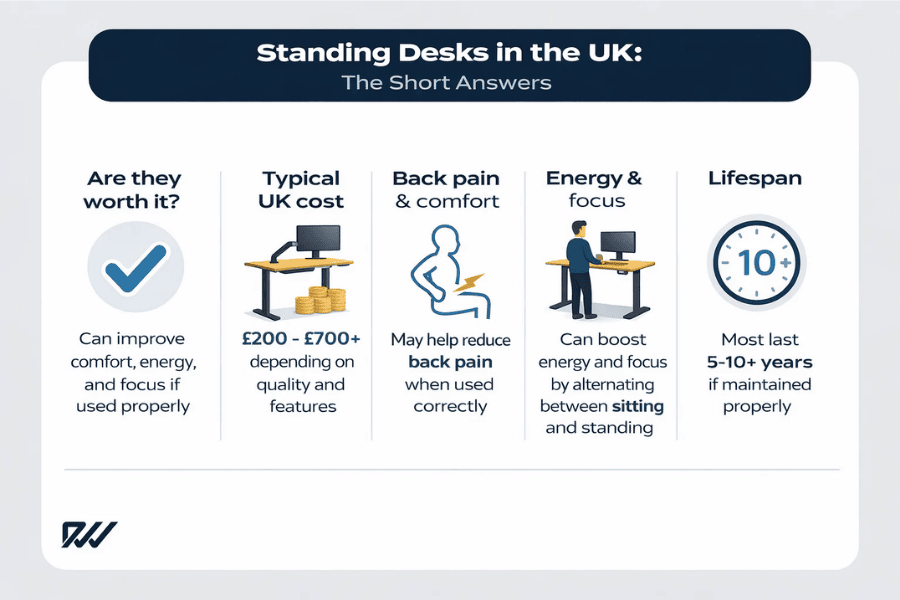
Standing desks in the UK: quick answers on cost, comfort, energy and lifespan.
Are standing desks worth it in 2026?
For most desk-based workers, yes—provided they are used correctly. The UK workforce is more sedentary than ever, and musculoskeletal disorders remain a leading cause of sickness absence.
A sit-stand desk allows regular posture changes, which is what NHS and HSE guidance actually recommends. The evidence shows that people who alternate between sitting and standing experience less back discomfort and better energy levels than those who sit all day. However, the benefit comes from movement, not simply standing more.
How much does a good standing desk cost in the UK?
A reliable electric standing desk suitable for daily use typically costs between £500 and £1,000 in the UK. Cheaper models exist, including converters and manual desks, but they often lack stability, height range or long warranties. For corporate or heavy-duty use, prices over £1,000 are common because of stronger frames and longer service life. In many cases, paying more upfront reduces maintenance and replacement costs over time.
Do standing desks really help back pain?
They can, but only as part of a broader ergonomic approach. Standing desks reduce the amount of time the spine spends under constant seated load, which is a key contributor to lower-back pain. UK occupational health studies show that people who regularly change posture report less stiffness and discomfort. However, poor standing posture, badly positioned monitors or long static standing periods can still cause pain, so correct setup is essential.
Are electric standing desks expensive to run in the UK?
No. Electric standing desks use very little electricity because the motors only run for a few seconds when adjusting height. Even with several adjustments per day, the annual energy cost is typically well under £5 at current UK electricity prices. In practical terms, running an electric desk costs far less than most office equipment such as monitors or desktop PCs.
What is the lifespan of a standing desk?
A well-built electric standing desk from a reputable UK supplier should last 8–15 years in normal use. Commercial-grade models often last even longer, especially when backed by 5–10 year warranties. Budget desks may wear out sooner due to weaker motors and frames. Lifespan depends largely on build quality and how heavily the desk is loaded and adjusted.
Are standing desks suitable for small home offices?
Yes, but size and footprint matter. Many electric desks are available in 120–140 cm widths, which fit comfortably in most UK box rooms and spare bedrooms. Desk converters are another option where space is very tight. The key is ensuring there is still enough depth for safe monitor positioning, which is often overlooked in small rooms.
Can my employer pay for a standing desk? (UK Tax & DSE Rules)
Often, yes. Under UK Display Screen Equipment regulations, employers must provide suitable equipment if an employee needs it for health reasons. Many companies will fund or part-fund a standing desk following a DSE or occupational health assessment. In some cases, desks provided for work can also be exempt from personal tax, particularly if they are required for health and safety or to perform your job effectively.