The Ultimate Ergonomic Chair Buying Guide (2026 Edition)
If you spend more than a few hours a day sitting at a desk, your chair isn’t just furniture — it’s equipment. The right ergonomic chair can reduce back pain, improve posture, support long-term spinal health, and help you stay focused throughout the workday.
But choosing the right chair isn’t simple.
Should you choose a mesh classic like the Herman Miller Aeron?
A movement-focused design like the Herman Miller Embody?
A modular solution such as the Ergochair Adapt 660 Series?
Or something highly specialised like the VELA Tango 700E?
With prices ranging from a few hundred pounds to specialist clinical-level investment pieces, the stakes are high. This guide is designed to help you:
- Understand what truly makes a chair ergonomic
- Compare leading models across different categories
- Identify the best option for your body type, workspace, and budget
- Invest confidently in long-term comfort
Whether you’re setting up a home office, upgrading a corporate workspace, or specifying seating for a specialist environment, this guide will walk you through everything you need to know.
Why Investing in a High-Quality Ergonomic Chair Matters
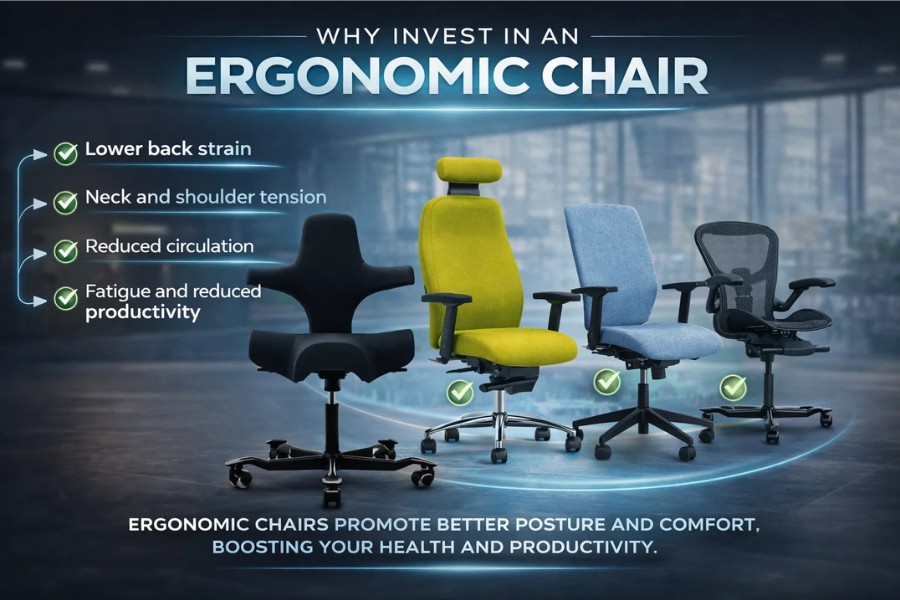
The Cost of Poor Posture
Back pain remains one of the most common workplace complaints. Prolonged sitting in a poorly designed chair can lead to:
- Lower back strain
- Neck and shoulder tension
- Reduced circulation
- Fatigue and reduced productivity
A standard office chair often lacks adjustability, lumbar precision, and dynamic movement support. Over time, this forces your body to compensate — and that compensation becomes discomfort.
High-quality ergonomic chairs are designed to support the natural curvature of your spine, encourage movement, and adapt to your body rather than forcing you to adapt to the chair.
Productivity & Long-Term Comfort
Comfort isn’t a luxury — it’s a performance factor.
When your chair supports your posture properly:
- You concentrate longer
- You experience less end-of-day fatigue
- You shift positions naturally instead of fidgeting
Chairs such as the Humanscale Freedom task with headrest and the RH Logic 220 High Back Office Chair are engineered specifically for full-day sitting, combining precision adjustments with movement-responsive mechanisms.
For users with specific requirements — such as mobility support or rehabilitation settings — specialist seating like the VELA Tango 300E offers stability and assisted movement features that go beyond traditional task seating.
Who This Guide Is For
This guide is built for:
- Home office professionals working 6–10+ hours daily
- Corporate buyers specifying seating for teams
- Users experiencing back or posture-related discomfort
- Big & tall users needing reinforced support
- Sit-stand desk users exploring saddle seating options
- Clinical and specialist environments requiring mobility-enabled chairs
Rather than simply listing products, we’ll break down:
- How different mechanisms work
- Which back heights suit which users
- When mesh outperforms upholstery
- When a saddle design makes more sense than a traditional chair
- And when investing in premium engineering truly pays off
In the next section, we’ll look at the most important criteria for choosing the right ergonomic chair — so you can evaluate every model properly before comparing specific recommendations.
How to Choose the Right Ergonomic Chair
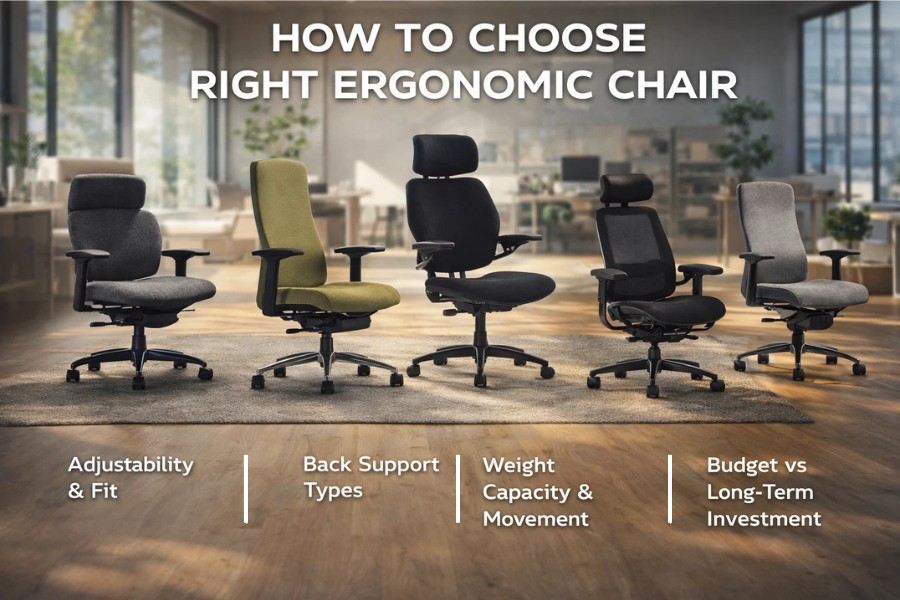
Choosing the best ergonomic chair isn’t about brand alone — it’s about fit, adjustability, movement, and long-term support. A chair that works perfectly for one person may feel completely wrong for another.
Below are the key criteria you should evaluate before deciding.
- Adjustability & Fit: The Foundation of Ergonomics
An ergonomic chair must adapt to your body — not the other way around.
At minimum, look for:
- Seat height adjustment (so feet rest flat on the floor)
- Seat depth adjustment (2–3 fingers between seat edge and knees)
- Lumbar support control (height and/or tension adjustable)
- Armrest adjustment (height, width, depth or pivot)
- Backrest recline or tilt mechanism
- Optional headrest for longer sitting sessions
For example, the RH Logic 200 Medium Back Office Chair offers precise seat depth and back angle control, making it ideal for users who need fine-tuned support.
Meanwhile, the Ergochair Adapt 650 Series provides modular adjustments across multiple configurations, making it highly adaptable for varied users.
Tip: The more hours you sit, the more adjustment range you’ll benefit from.
- Back Support Types: High Back vs Dynamic Movement
Back support isn’t one-size-fits-all.
Medium Back Chairs
Suitable for:
- Average-height users
- Shorter sitting periods
- Shared workspaces
Example: RH Logic 200 Medium Back Office Chair
High Back Chairs
Better for:
- 8+ hour workdays
- Taller users
- Users needing upper-back or neck support
Example: RH Logic 220 High Back Office Chair
Dynamic & Responsive Support
Some chairs actively respond to your movement rather than relying on manual levers.
The Humanscale Freedom task with headrest uses weight-sensitive recline, automatically adjusting resistance as you lean back.
The Herman Miller Embody is engineered to distribute pressure across the back through a flexible support matrix — encouraging micro-movements throughout the day.
If you prefer traditional mesh airflow and iconic design, the Herman Miller Aeron remains a benchmark in ergonomic seating.
- Weight Capacity & Body Type Considerations
Fit is critical — especially for users outside standard sizing ranges.
Big & Tall Users
Look for:
- Reinforced frame
- Wider seat pan
- Higher weight capacity
- Stronger gas lift mechanism
The BodyBilt J3504 Big & Tall chair is specifically engineered for extended durability and larger body frames, offering enhanced support and adjustability.
Petite or Smaller Users
Seat depth adjustment becomes particularly important. Chairs with modular sizing (like the Adapt range) allow a more precise fit.
Multi-User Environments
If the chair will be shared:
- Choose models with quick-adjust features
- Consider intuitive mechanisms
- Avoid overly complex adjustment systems
- Mechanisms & Movement: Why Static Sitting Is the Enemy
The human body isn’t designed to stay still.
Modern ergonomic chairs encourage active sitting, meaning:
- Synchronous tilt (seat and back move together)
- Tension control
- Rocking or recline lock options
- Weight-sensitive mechanisms
Chairs such as the Ergochair Adapt 680 Series and the Herman Miller Embody promote subtle movement, which improves circulation and reduces fatigue.
If you use a sit-stand desk, saddle seating like the HÅG Capisco 8106-0001 supports upright posture and transitions easily between sitting and standing heights.
- Budget vs Long-Term Investment
Ergonomic chairs typically fall into three broad tiers:
Entry to Mid-Range (£400–£800)
Suitable for:
- Home offices
- Moderate daily use
- Budget-conscious buyers
Examples:
- Ergochair Intui- Bondai
- HÅG Capisco Puls 8010-0003
Professional Tier (£800–£1,400)
Designed for:
- Full-time office use
- Advanced adjustability
- Long-term durability
Examples:
- Ergochair Adapt 660 Series
- RH Logic 220 High Back Office Chair
- Herman Miller Aeron
Specialist & Clinical Tier (£2,000+)
For:
- Assisted mobility
- Rehabilitation
- Specialist care environments
Examples:
- VELA Tango 700E
- VELA Tango 700E – Power wheels
These chairs offer stability systems and powered features not found in standard office seating.
Quick Summary: What Matters Most
If you only remember five things, make it these:
- Fit matters more than brand.
- Adjustability is non-negotiable for long hours.
- Movement is healthier than static support.
- Back height should match your body and workload.
- Price should reflect usage duration — not aesthetics.
Next, we’ll move into a side-by-side comparison overview of the chairs featured in this guide, so you can quickly narrow down which models deserve deeper consideration.
Ergonomic Chair Comparison Overview
Below is a high-level comparison of all the chairs featured in this guide. This visual snapshot helps you evaluate key features, ideal use-cases, and where each chair sits in terms of adjustability and investment.
At-a-Glance Comparison Table
The following comparison table summarises key differences between popular ergonomic office chairs, including price range, adjustability level and ideal use case.
| Chair Model | Price Range | Best For | Back Support | Adjustability Level | Key Strengths |
|---|---|---|---|---|---|
| BodyBilt J3504 Big & Tall | £1,390+ | Larger users, high durability | High | Advanced | Built for strength & comfort |
| Ergochair Adapt Series (610–680) | £830–£1,369 | Full adjustability | Variable | Very High | Modular options, extensive adjust |
| Ergochair Intui — Bondai | £409 | Budget ergonomic seating | Medium | Moderate | Great value entry chair |
| Ergochair Zenki Plus | £725 | Mid-range comfort | Medium | Good | Quality build at a solid price |
| HÅG Capisco 8106 | £1,081+ | Active upright sitting | Medium / unique | Moderate | Ideal for sit-stand desks |
| HÅG Capisco Puls (8010 / 8020) | £457–£516 | Saddle style value | Medium | Moderate | Affordable saddle seating |
| Herman Miller Aeron | £999–£1,049 | Classic ergonomic design | High | High | Time-tested, breathable mesh |
| Herman Miller Embody | £1,082+ | High-performance office tasks | High | Advanced | Back-pressure redistribution |
| Humanscale Freedom Task Chair | £999+ | Weight-adaptive recline | High | High | Minimal adjustment fuss |
| RH Logic 200 Medium Back | £1,275–£1,319 | Professional support | Medium | Advanced | Excellent contour support |
| RH Logic 220 High Back | £1,319–£1,365 | Extended back support | High | Advanced | Great for taller users |
| RS74 Ergonomic Office Chair | £660–£900 | Everyday office work | Medium | Good | Balanced feature set |
| VELA Tango 300E | £3,988+ | Specialist seating | High | Very High | Clinical-grade support |
| VELA Tango 700E | £2,965+ | Specialist seating | High | Very High | High-support ergonomic mobility |
| VELA Tango 700E – Power Wheels | £4,002+ | Powered mobility support | High | Very High | Ideal where mobility assistance is needed |
How to Use This Table
✨ Price Range helps you filter by budget quickly.
✨ Best For identifies the primary use case — not just a generic category.
✨ Back Support and Adjustability Level help you match chairs to your ergonomic priorities (e.g., extensive adjustments vs straightforward comfort).
✨ Key Strengths points you toward the chairs that excel for specific needs.
How This Helps You Choose
Here’s how to interpret the table based on common needs:
- Home office users on a budget:
Start with Ergochair Intui — Bondai or Ergochair Zenki Plus for good adjustability without a premium price tag. - Professional full-time sitters:
Chairs like Herman Miller Aeron, RH Logic 220 High Back, or Ergochair Adapt Range (630–680) offer superior long-day comfort and support. - Active or adjustable workstations:
HÅG Capisco 8106 is perfect for sit-stand desks and dynamic posture work. - Big & tall users:
The BodyBilt J3504 prioritises structural support and size-inclusive ergonomic design. - Specialist or clinical environments:
VELA Tango 300E / 700E / 700E Power Wheels are engineered for mobility needs and extended therapeutic seating.
What’s Next
Now that you have a clear comparison overview, the next section will dive into individual chair reviews, starting with the best everyday ergonomic chairs — perfect for most office users seeking a balance of comfort, adjustability, and long-term support.
Best Ergonomic Chairs for Everyday Office Use
If you’re looking for a high-quality ergonomic chair for daily office work — without moving into ultra-premium or specialist territory — this section is for you.
These chairs strike a balance between:
- Comfort for 6–8+ hour workdays
- Solid adjustability
- Professional build quality
- Sensible investment level
They’re ideal for home offices, SMEs, shared workspaces, and growing teams.
RS74 Ergonomic Office Chair
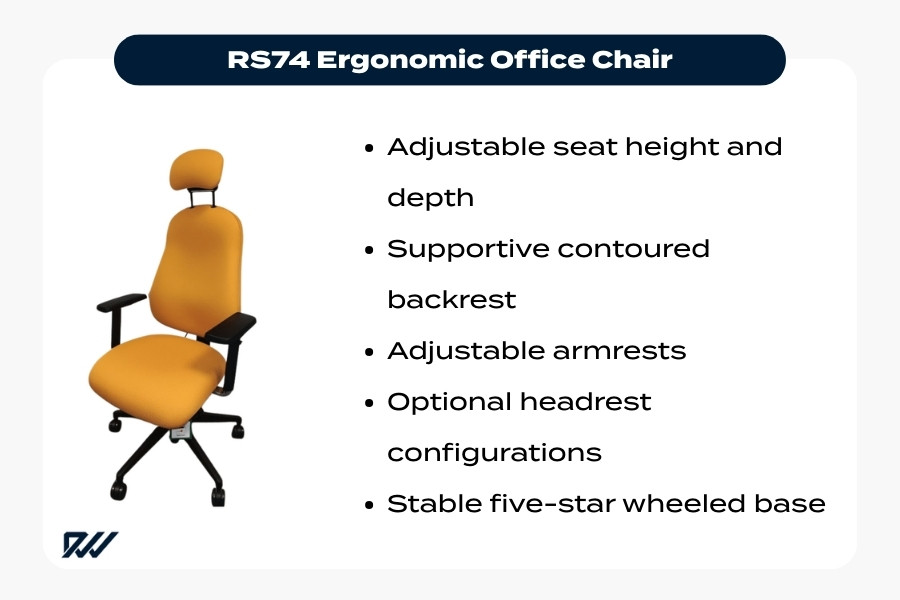
Best for: Balanced performance at a mid-range price point
The RS74 offers a strong combination of ergonomic adjustability and accessible pricing. It’s a practical choice for users who need proper lumbar support and posture alignment without stepping into premium-tier budgets.
Key Features
- Adjustable seat height and depth
- Supportive contoured backrest
- Adjustable armrests
- Optional headrest configurations
- Stable five-star wheeled base
Why It Works
The RS74 provides the core ergonomic essentials most office users need. It supports neutral posture and allows users to fine-tune their position throughout the day.
Ideal For
- Home office professionals
- Growing teams
- Businesses furnishing multiple desks
Ergochair Intui- Bondai
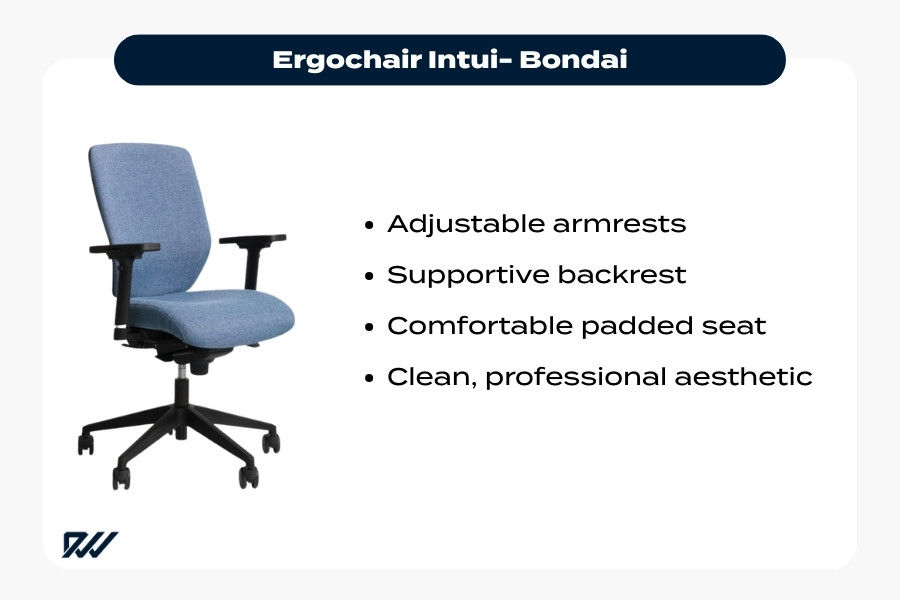
Best for: Entry-level ergonomic seating with dependable support
The Intui-Bondai is an excellent starting point if you’re upgrading from a basic office chair. It delivers ergonomic fundamentals without complexity.
Key Features
- Adjustable armrests
- Supportive backrest
- Comfortable padded seat
- Clean, professional aesthetic
Why It Works
It’s straightforward, easy to adjust, and suitable for moderate daily use. For users working standard office hours without advanced posture requirements, it offers reliable comfort.
Ideal For
- Budget-conscious buyers
- Hybrid workers
- Home offices with lighter use
Ergochair Zenki Plus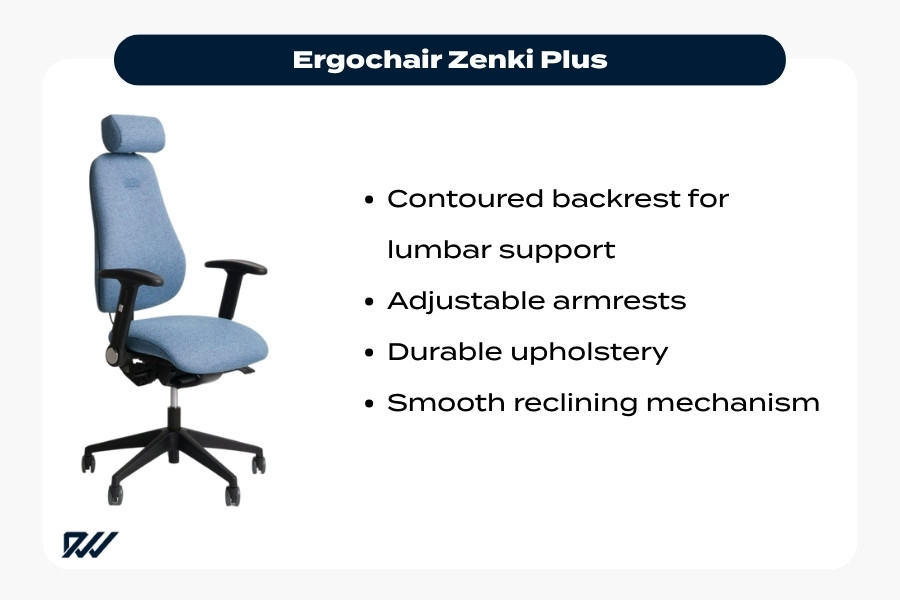
Best for: Mid-range users wanting enhanced comfort
The Ergochair Zenki Plus sits above entry-level seating, offering improved build quality and ergonomic refinement.
Key Features
- Contoured backrest for lumbar support
- Adjustable armrests
- Durable upholstery
- Smooth reclining mechanism
Why It Works
It bridges the gap between value seating and professional-grade task chairs. For users working longer days who want better contouring and more adjustment than basic models provide, this is a strong option.
Ideal For
- 6–8 hour daily users
- Home offices upgrading from standard chairs
- Small business environments
Choosing Between These Three
If you’re deciding within this category:
- Tight budget? → Intui offers reliable essentials.
- Balanced performance and value? → RS74 provides strong all-round capability.
- More daily sitting and comfort refinement? → Zenki Plus is the upgrade path.
All three deliver meaningful ergonomic improvements over standard office chairs — but the right choice depends on daily sitting time and required adjustability.
Next, we’ll explore one of the most versatile and customisable ranges in this guide:
The Ergochair Adapt Series – Modular Ergonomic Seating
The Ergochair Adapt Series represents one of the most flexible and adjustable families of chairs in this guide. With a range of models from the Adapt 610 through the Adapt 680, this series lets you choose the level of performance and adjustability that suits your body type, work habits, and budget — without stepping into ultra-premium price tags.
Each model in the Adapt Series shares a core ergonomic philosophy:
- Highly adjustable mechanisms built to support extended sitting periods
- Modular design so users can tailor fit and comfort
- Consistent quality and durability across the range
Below you’ll find an overview of each model and what makes it stand out.
Overview: What Sets the Adapt Series Apart
Before we get into individual models, here’s what to expect across the Adapt range:
- Progressive adjustability: From more basic, easy-to-set models up to versions with advanced recline, tension, and support tuning.
- Multiple back height options: Helps match the chair to your posture needs (e.g., taller users, posture support).
- Headrests and armrest adjustability: Especially useful for users with neck strain or multi-tasking workflows.
- Consistent build quality: These chairs are built to last in busy work environments.
The Adapt series gives you more control than most standard ergonomic chairs — which is why it’s popular with serious home office users, creative professionals, and anyone who spends long hours sitting.
Ergochair Adapt 610 Series
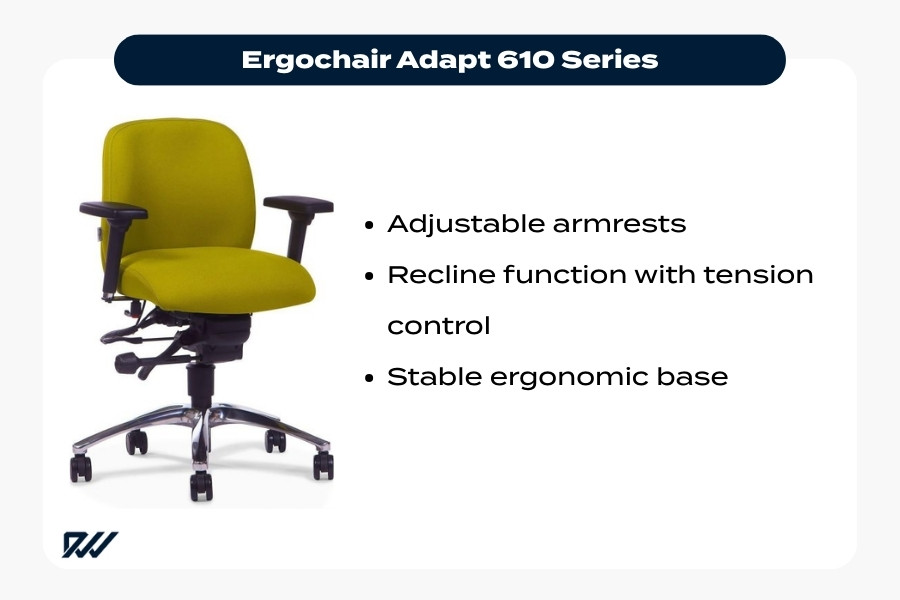
Best for: Intro to high adjustability
The Ergochair Adapt 610 is a strong starting point for users who want more control than a basic office chair — without the complexity or price of top-tier models.
Key Features
- Adjustable armrests
- Recline function with tension control
- Stable ergonomic base
Why It Works
It bridges everyday chairs and fully customisable ergonomic seating. A great choice if you’re transitioning from basic office seating.
Ergochair Adapt 620 Series
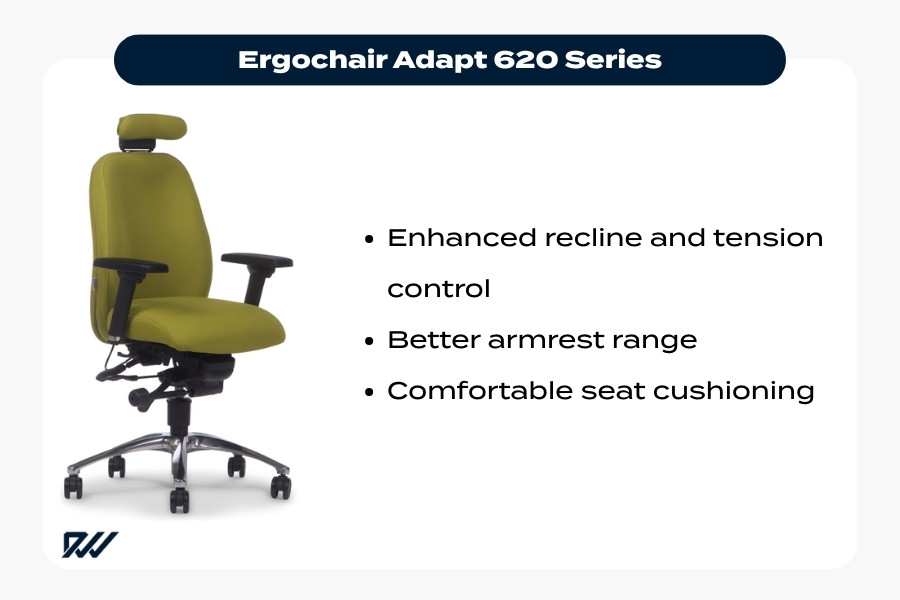
Best for: Stepped-up adjustability
The Ergochair Adapt 620 builds on the 610 foundation with smoother adjustments and improved support.
Key Features
- Enhanced recline and tension control
- Better armrest range
- Comfortable seat cushioning
Why It Works
If you want noticeable improvements in adjustability and long-sitting comfort without a big price increase, the 620 is a solid next step.
Ergochair Adapt 630 Series
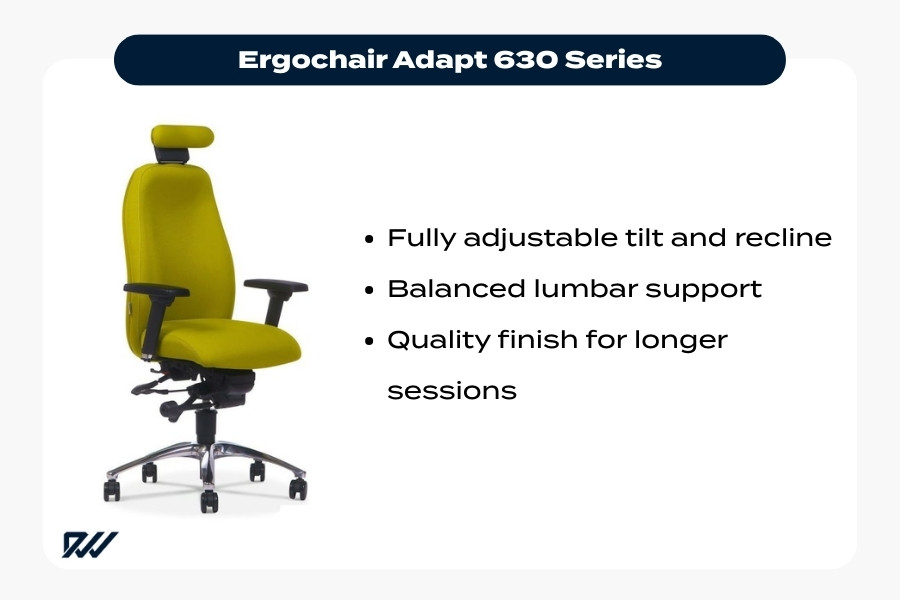
Best for: Everyday professionals
The Adapt 630 is positioned as a reliable chair for full-time office use, providing a more refined sit with ergonomic balance and adjustability.
Key Features
- Fully adjustable tilt and recline
- Balanced lumbar support
- Quality finish for longer sessions
Why It Works
Ideal for users who sit 6–10 hours daily and want a chair that can be dialled in precisely.
Ergochair Adapt 640 Series
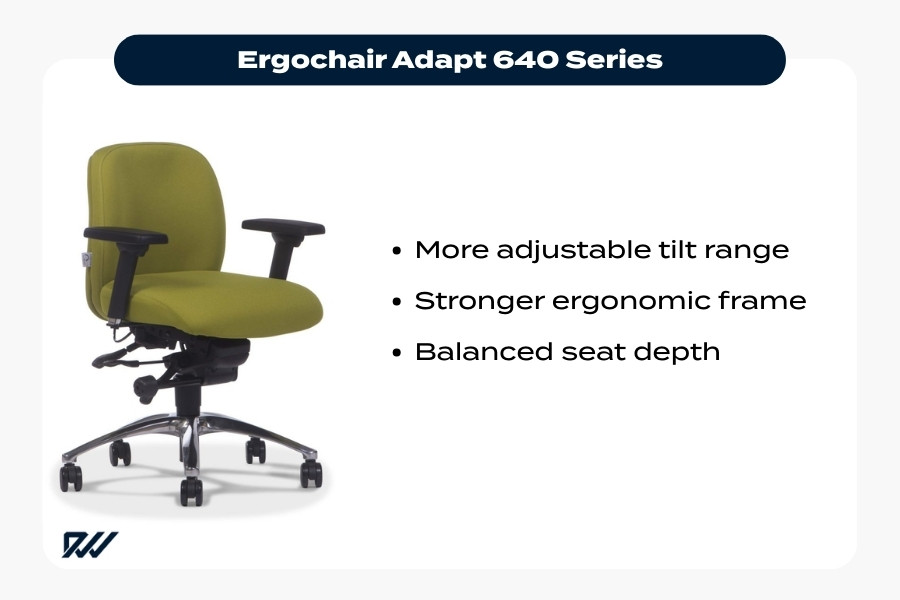
Best for: Enhanced support and stability
The Ergochair Adapt 640 adds incremental comfort and ergonomic refinement over lower-tier adapt models, making it good for heavier day-to-day use.
Key Features
- More adjustable tilt range
- Stronger ergonomic frame
- Balanced seat depth
Why It Works
For users who want a step up in comfort without reaching premium pricing, this model offers tangible benefits.
Ergochair Adapt 650 Series
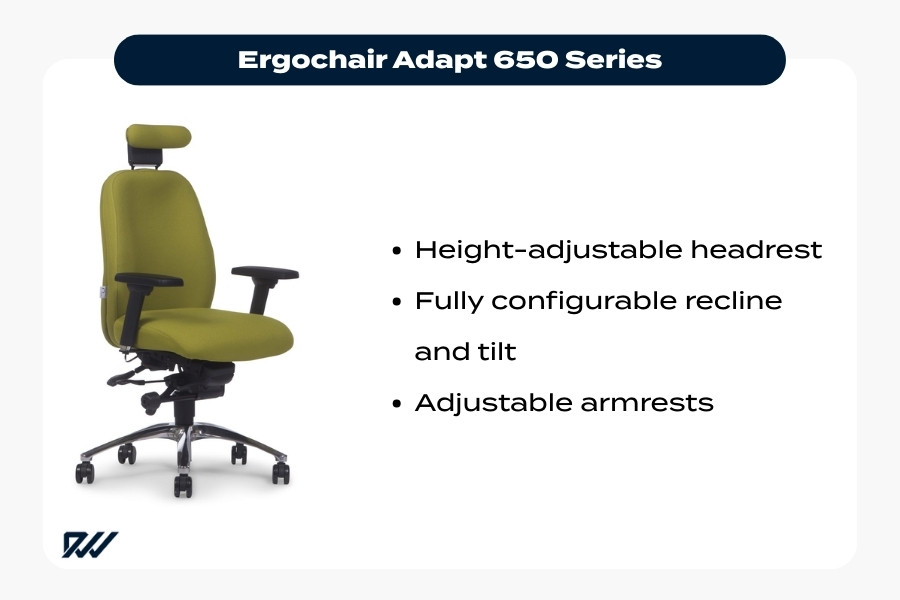
Best for: Users seeking personalised comfort
The Ergochair Adapt 650 introduces more nuanced adjustability tailored to intensive sitting and frequent position changes.
Key Features
- Height-adjustable headrest
- Fully configurable recline and tilt
- Adjustable armrests
Why It Works
This model gives you features approaching executive-level chairs without overwhelming complexity.
Ergochair Adapt 660 Series
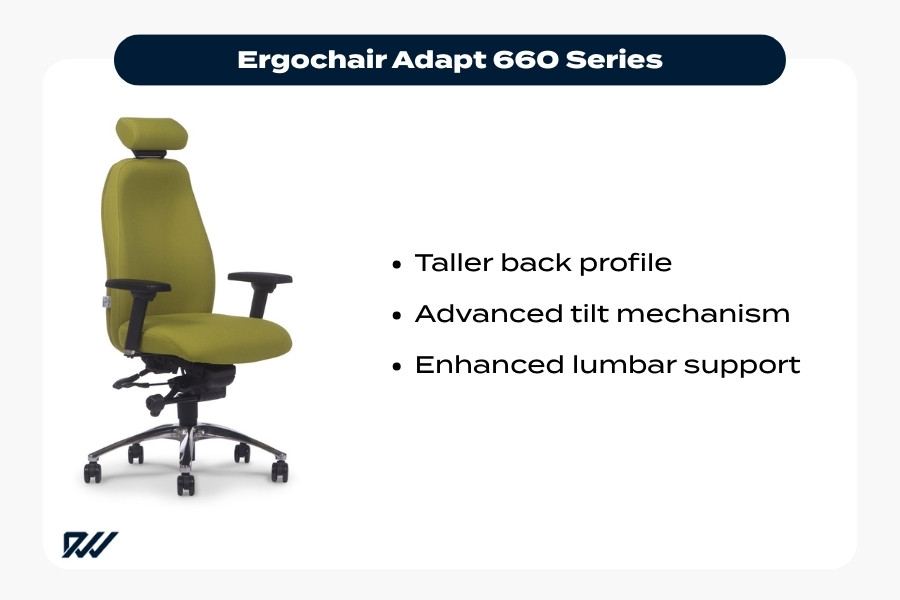
Best for: High back support and enhanced posture control
The Ergochair Adapt 660 increases back height and postural options, making it suitable for taller users or those who prefer more upper-back support.
Key Features
- Taller back profile
- Advanced tilt mechanism
- Enhanced lumbar support
Why It Works
Great choice if you want a chair that feels supportive from lower back to upper shoulders.
Ergochair Adapt 680 Series
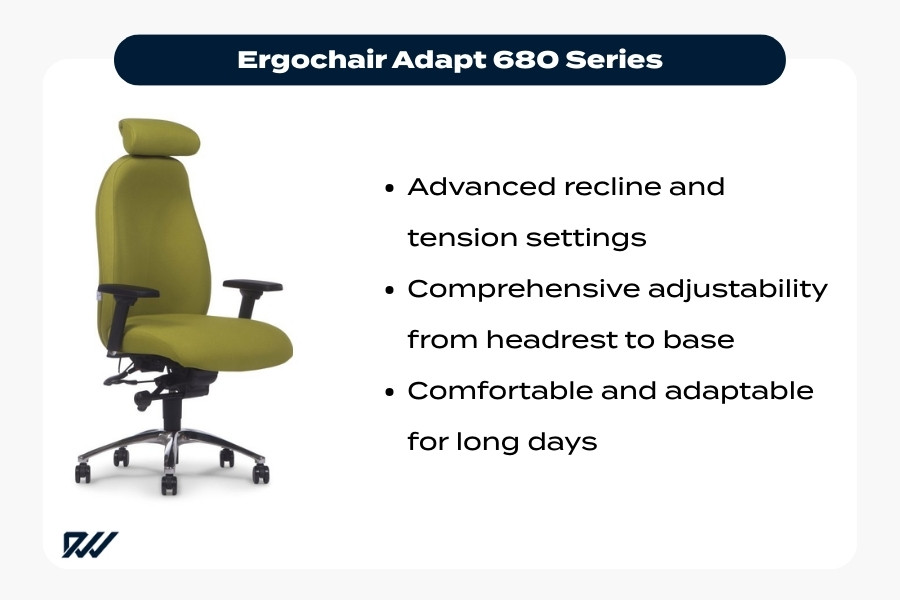
Best for: Users who demand flexibility and refinement
The Ergochair Adapt 680 sits at the top of the series — offering the broadest range of adjustments and most complete ergonomic control.
Key Features
- Advanced recline and tension settings
- Comprehensive adjustability from headrest to base
- Comfortable and adaptable for long days
Why It Works
This model is ideal if you spend long hours at your desk and want near-complete control over fit and feel.
Who Should Choose the Adapt Series?
The Adapt range is ideal if you value:
✔ Customisation over one-size-fits-all
✔ Multiple users sharing a chair
✔ Long duration sitting
✔ A balance of performance and price
Compared with fixed-configuration chairs or basic office seating, the Adapt series delivers more ergonomic nuance — which matters when you sit all day.
Quick Tips for Choosing Within the Adapt Series
- Limited budget, want more than basics? → Start with Adapt 610 or 620.
- Frequent day-long sitting? → Look at 630 or 640.
- Need upper back + head support? → Choose 660.
- Want maximum adjustability? → The 680 is your go-to.
Next up, we’ll dive into big & tall and specialist ergonomic chairs like the BodyBilt J3504 and the VELA Tango series — chairs designed for larger body types and clinical or mobility-assisted environments.
Best Ergonomic Chairs for Big & Tall Users
Standard office chairs are typically designed around average body dimensions. For taller or heavier users, that often means:
- Insufficient seat width
- Limited weight capacity
- Inadequate lumbar positioning
- Reduced long-term durability
If a chair doesn’t properly fit your frame, no amount of adjustment will make it comfortable.
For users who need reinforced support and increased sizing, purpose-built ergonomic seating is essential.
BodyBilt J3504 Big & Tall chair
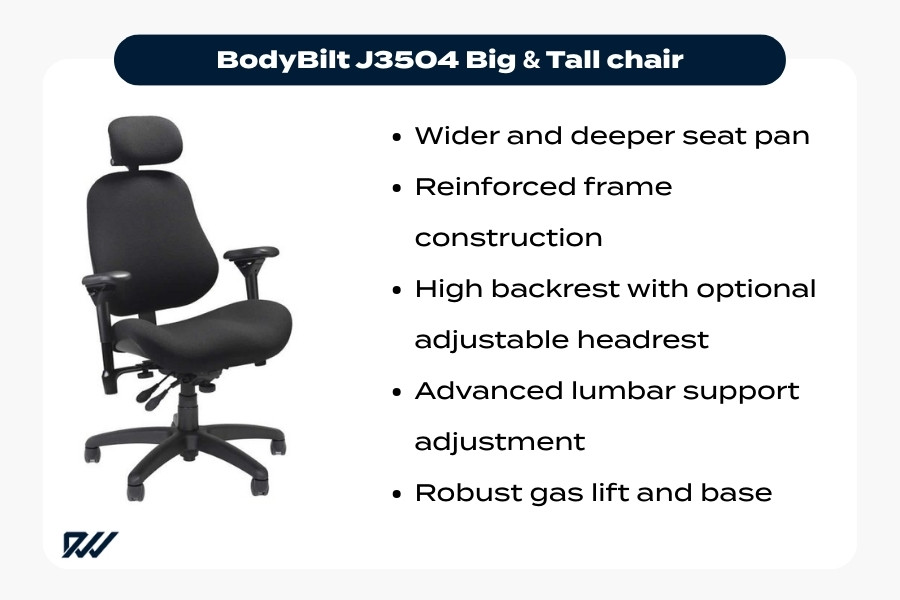
Best for: Larger users requiring reinforced structure and advanced adjustability
The BodyBilt J3504 is engineered specifically for big and tall individuals. Unlike standard task chairs that simply scale up dimensions slightly, this model is built with durability, wider seating, and structural strength as core design principles.
Key Features
- Wider and deeper seat pan
- Reinforced frame construction
- High backrest with optional adjustable headrest
- Advanced lumbar support adjustment
- Robust gas lift and base
Why It Works
This chair is designed to support extended sitting without compromising posture or structural integrity. The deeper seat allows proper thigh support, while adjustable lumbar positioning helps align the lower spine correctly — crucial for long workdays.
For users over average height or weight ranges, this type of purpose-built chair significantly improves comfort and reduces strain.
Ideal For
- Taller users
- Heavier users requiring higher weight capacity
- Individuals who have struggled with standard office chair sizing
- Corporate environments needing inclusive seating options
What Big & Tall Users Should Look For
If you’re evaluating ergonomic chairs in this category, prioritise:
- Seat Depth & Width
There should be:
- Full thigh support
- 2–3 finger gap behind the knees
- No pressure on hips from narrow seat edges
- Reinforced Mechanisms
Larger frames place greater stress on tilt and recline systems. Look for:
- Heavy-duty tilt mechanisms
- Durable gas lift systems
- Stable five-star bases
- Back Height & Lumbar Range
Taller users often find lumbar support positioned too low on standard chairs. A proper big & tall chair ensures:
- Adjustable lumbar height
- Adequate upper back support
- Optional headrest positioning
When to Choose a High Back Professional Chair Instead
Some taller users may also consider high-back professional chairs such as the RH Logic 220 High Back Office Chair or the Ergochair Adapt 660 Series.
These models offer extended back support but may not provide the same structural reinforcement or wider seat dimensions as a purpose-built big & tall chair.
If durability and weight capacity are primary concerns, the BodyBilt remains the safer choice.
Quick Decision Guide
- Need reinforced durability and wider fit? → BodyBilt J3504
- Tall but average build, want premium ergonomic performance? → Consider high-back professional chairs
- Corporate buyer specifying inclusive seating? → Prioritise at least one big & tall option in your selection
Next, we’ll move into Premium Ergonomic Task Chairs — including globally recognised models designed for full-day performance, executive environments, and users demanding top-tier ergonomic engineering.
Premium Ergonomic Task Chairs: Top Choices for Full-Time Comfort
If you spend long hours at your desk — whether as a remote worker, executive, professional creator, or team lead — premium ergonomic chairs can make a noticeable difference. These models combine advanced mechanisms, critical support features, and durable build quality to help reduce fatigue and improve posture throughout extended workdays.
Below are some of the most highly regarded options featuring thoughtful design, ergonomic excellence, and lasting comfort.
Herman Miller Aeron
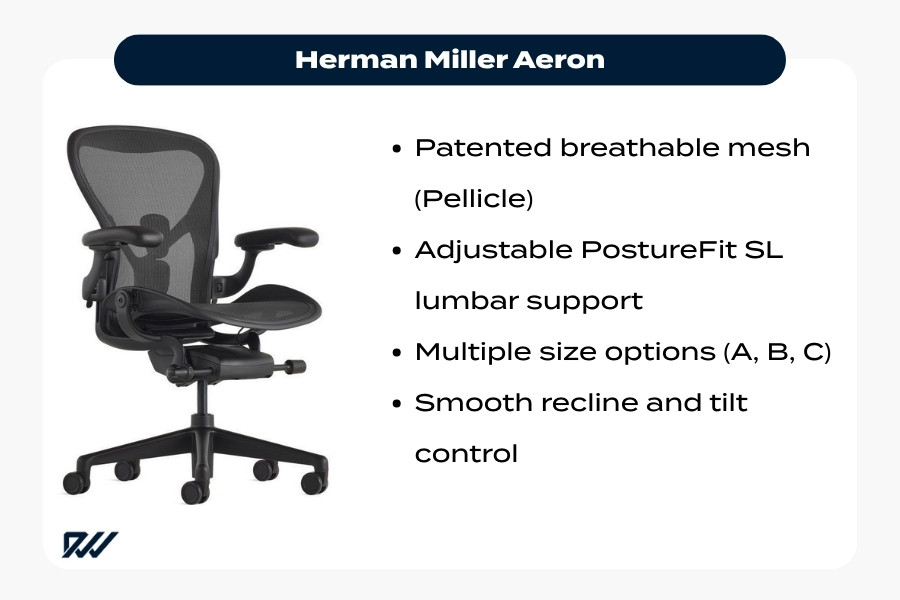
Best for: Classic ergonomic performance with breathable mesh
The Herman Miller Aeron is one of the most iconic ergonomic chairs ever made, and for good reason. Its mesh suspension system distributes weight evenly, reduces pressure points, and stays cool throughout long sessions.
Key Features
- Patented breathable mesh (Pellicle)
- Adjustable PostureFit SL lumbar support
- Multiple size options (A, B, C)
- Smooth recline and tilt control
Why It Works
Rather than relying on a foam cushion, the Aeron’s mesh surface adapts to your body, providing firm yet flexible support. Its proven performance has made it a benchmark in ergonomic seating for decades.
Ideal For
- Long daily sitting (8+ hours)
- Users who prefer a firm, supportive feel
- Warm office environments
- Professionals seeking timeless comfort
Herman Miller Embody
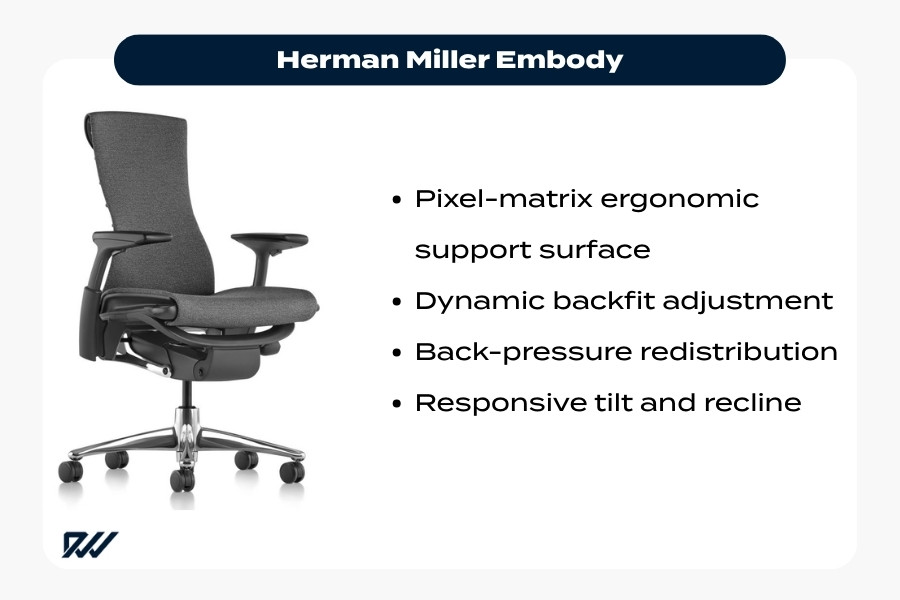
Best for: Posture-focused support and active sitting
The Herman Miller Embody takes a unique approach to ergonomic comfort with its pixel-matrix back and seat design, engineered to distribute pressure and promote movement throughout the day.
Key Features
- Pixel-matrix ergonomic support surface
- Dynamic backfit adjustment
- Back-pressure redistribution
- Responsive tilt and recline
Why It Works
Instead of a traditional lumbar pad, the Embody’s design encourages micro-movement by distributing pressure evenly across your back. This helps reduce stiffness and discomfort during long seated work.
Ideal For
- Daily heavy users
- Users with back tension or posture concerns
- Creative and professional work environments
Humanscale Freedom task with headrest
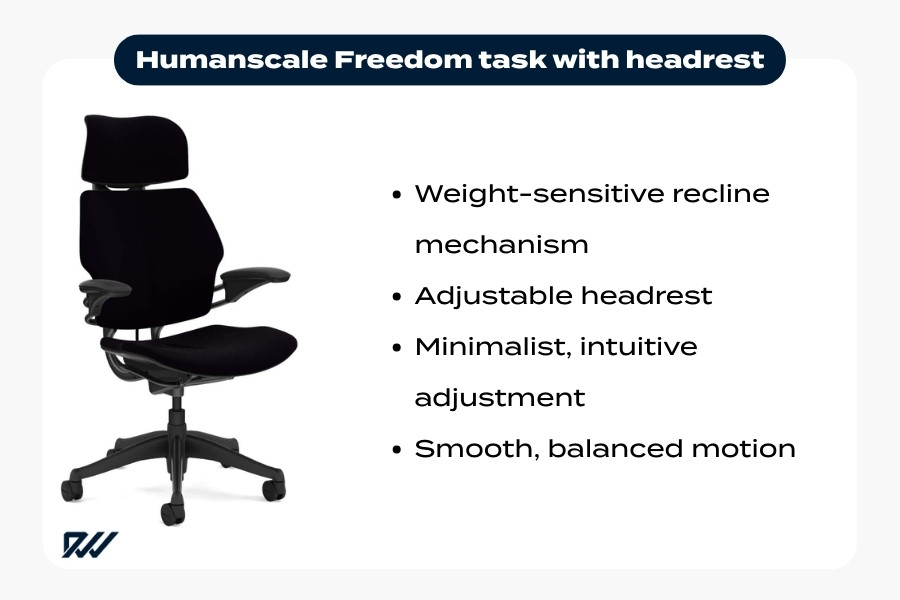
Best for: Hands-free recline and weight-adaptive comfort
The Humanscale Freedom task chair’s standout feature is its weight-sensitive recline, which automatically adjusts resistance based on your body weight. Combined with a headrest, it supports natural movement and neck comfort.
Key Features
- Weight-sensitive recline mechanism
- Adjustable headrest
- Minimalist, intuitive adjustment
- Smooth, balanced motion
Why It Works
Rather than dozens of knobs and levers, Freedom’s design simplifies the experience with automatic responsiveness. It’s ideal for users who want ergonomic performance without complexity.
Ideal For
- Users who prefer intuitive, hands-off adjustment
- Long hours of sitting with frequent posture changes
- Professionals valuing seamless comfort
RH Logic 200 Medium Back Office Chair
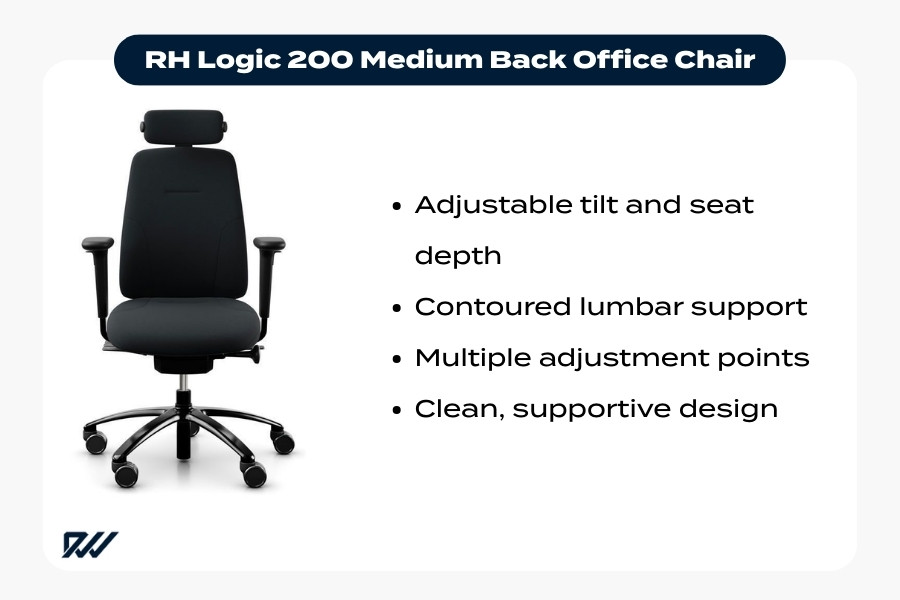
Best for: Balanced professional support with contour-focused seating
The RH Logic 200 provides strong contouring and ergonomic support in a medium-height profile, making it excellent for users focused on precision posture alignment.
Key Features
- Adjustable tilt and seat depth
- Contoured lumbar support
- Multiple adjustment points
- Clean, supportive design
Why It Works
With highly configurable support and subtle posture-enhancing contours, this chair is designed to keep your lower back positioned neutrally — helping reduce strain in long-term use.
Ideal For
- Office professionals sitting full days
- Users seeking precise posture support
- Shared workstations with adjustable features
RH Logic 220 High Back Office Chair
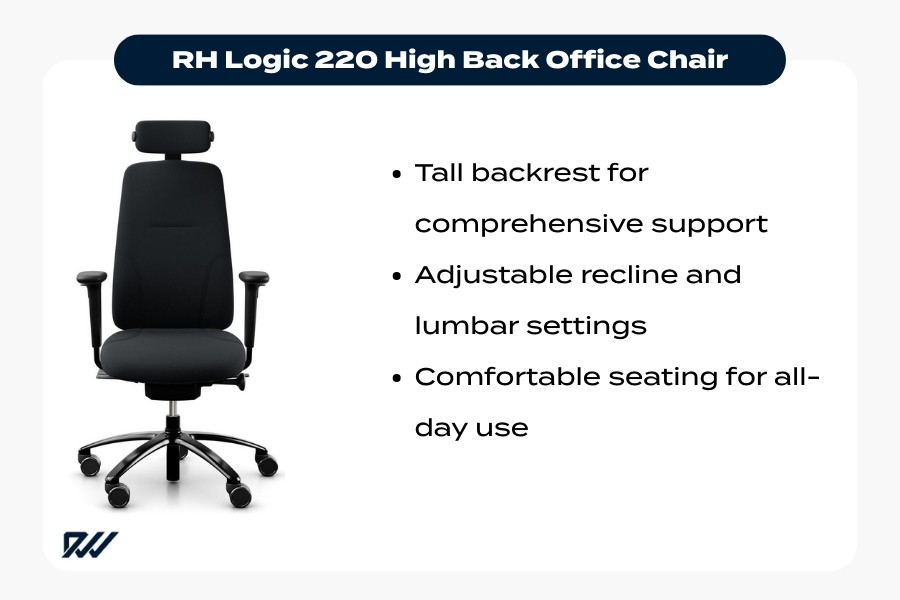
Best for: Extended back support for taller or full-time users
If you like everything about the Logic 200 but want more upper-back and shoulder support, the RH Logic 220 delivers an enhanced ergonomic footprint with a higher back.
Key Features
- Tall backrest for comprehensive support
- Adjustable recline and lumbar settings
- Comfortable seating for all-day use
Why It Works
For individuals who sit long hours or simply prefer a chair with more upper-back reach, the Logic 220 adds another dimension of comfort without sacrificing adjustability.
Ideal For
- Taller users
- Full-time office workers
- Users seeking extended back support
How to Choose Among These Premium Chairs
Here’s a simplified way to think about it:
- Want a proven classic with breathable comfort? → Herman Miller Aeron
- Prioritise posture and surface-level support? → Herman Miller Embody
- Prefer intuitive, dynamic recline? → Humanscale Freedom task with headrest
- Need tailored contour support at a professional level? → RH Logic 200
- Want additional upper-back and shoulder support? → RH Logic 220
Each of these chairs is engineered to handle extended hours without sacrificing comfort or adjustability — making them a go-to choice for serious sitters.
What Comes Next
In the next section, we’ll explore active sitting and saddle-style chairs — seating solutions perfect for sit-stand desks and users who prefer a more upright, movement-friendly posture.
Saddle & Active Sitting Chairs: Encouraging Movement at Your Desk
Traditional task chairs support a seated posture — but they don’t always encourage movement.
If you use a sit-stand desk, prefer a more upright spinal position, or want to reduce static sitting, saddle-style ergonomic chairs offer a very different experience. Instead of leaning back into a full backrest, these chairs promote:
- Open hip angles
- Upright spinal alignment
- Easier transitions between sitting and standing
- Active core engagement
They’re not for everyone — but for the right user, they can significantly improve comfort and posture.
HÅG Capisco 8106-0001
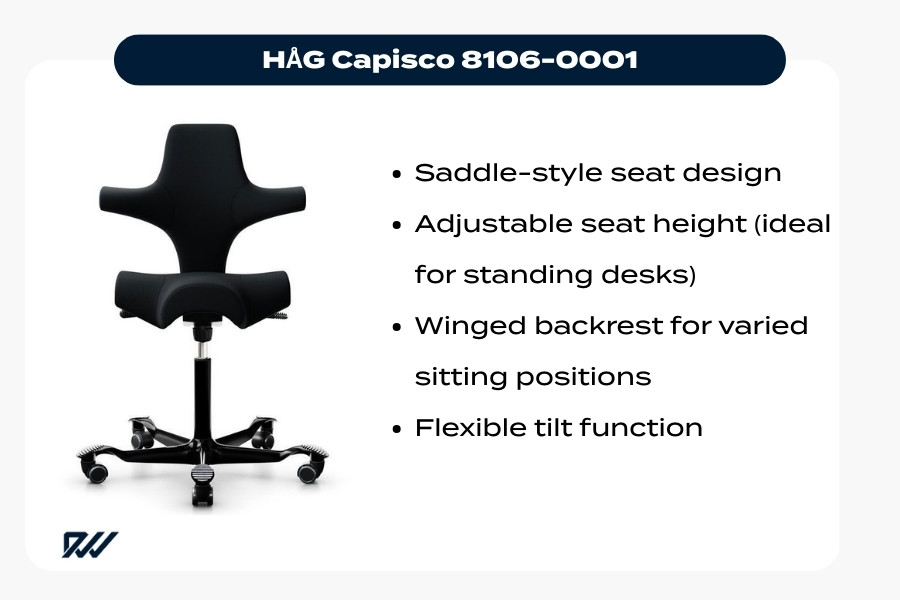
Best for: Sit-stand desks and dynamic workstyles
The Capisco 8106 is inspired by a horseback riding position. Its saddle seat encourages a naturally upright posture while allowing you to sit forwards, sideways, or even partially perched.
Key Features
- Saddle-style seat design
- Adjustable seat height (ideal for standing desks)
- Winged backrest for varied sitting positions
- Flexible tilt function
Why It Works
By opening the hip angle and promoting an upright spine, the Capisco reduces lower back compression often associated with traditional seated positions. It’s particularly effective for users who alternate frequently between sitting and standing.
Ideal For
- Sit-stand desk users
- Creative professionals
- Users who dislike leaning back for long periods
- Those seeking posture variety throughout the day
HÅG Capisco Puls 8010-0003
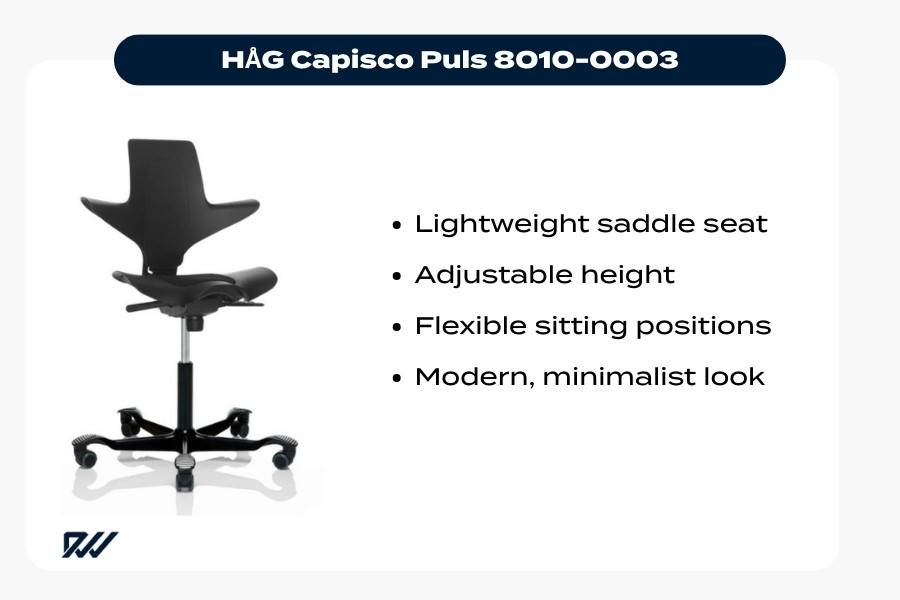
Best for: Affordable entry into active sitting
The Capisco Puls 8010 delivers the same core saddle concept in a lighter, more minimal design.
Key Features
- Lightweight saddle seat
- Adjustable height
- Flexible sitting positions
- Modern, minimalist look
Why It Works
If you’re curious about saddle seating but don’t want to commit to a fully upholstered premium model, the Puls 8010 offers an accessible introduction to active sitting.
Ideal For
- Home offices
- Modern, design-led spaces
- Users wanting posture variety at a lower investment
HÅG Capisco Puls 8020-0011
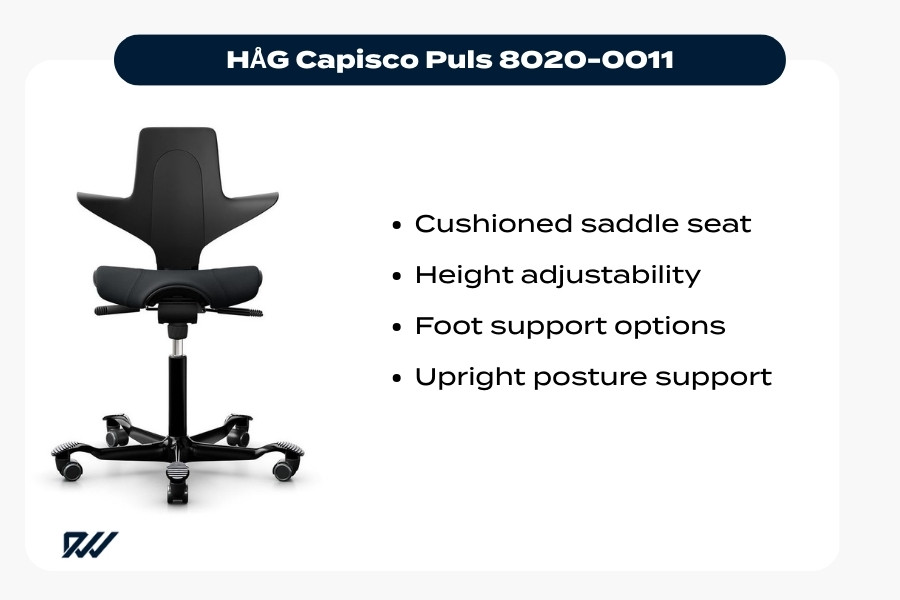
Best for: Added comfort within saddle seating
The Puls 8020 builds on the 8010 by incorporating additional seat padding for increased comfort during longer sessions.
Key Features
- Cushioned saddle seat
- Height adjustability
- Foot support options
- Upright posture support
Why It Works
For users who like the idea of saddle seating but want more cushioning for extended sitting, the 8020 offers a balanced solution.
Ideal For
- Hybrid sit-stand users
- Office environments encouraging movement
- Users transitioning from traditional seating
Are Saddle Chairs Right for You?
Saddle-style seating is ideal if:
✔ You use a sit-stand desk
✔ You prefer upright, forward-focused posture
✔ You want to reduce static sitting
✔ You’re comfortable engaging your core slightly more
They may not be ideal if:
✖ You prefer reclining support
✖ You rely heavily on headrests
✖ You need full upper-back contact throughout the day
For many users, saddle chairs work best when paired with a traditional ergonomic chair — allowing you to alternate positions during the day.
Quick Decision Guide
- Premium, fully upholstered saddle experience? → Capisco 8106
- Minimalist, affordable entry point? → Capisco Puls 8010
- More cushioning in a saddle format? → Capisco Puls 8020
Next, we’ll explore Specialist & Clinical Ergonomic Chairs, including the VELA Tango range — designed for users requiring enhanced stability, assisted mobility, and therapeutic seating support.
Specialist & Clinical Ergonomic Chairs: Stability, Support & Assisted Mobility
Not all ergonomic seating is designed purely for office productivity. In clinical, rehabilitation, and specialist environments, seating must deliver:
- Enhanced stability
- Assisted movement
- Safety-focused design
- Long-duration comfort
- Greater adjustability for individual care needs
This is where specialist chairs go beyond traditional task seating.
The VELA Tango range is engineered for users who require more than posture support alone — offering mobility assistance, controlled movement, and high levels of ergonomic customisation.
VELA Tango 300E
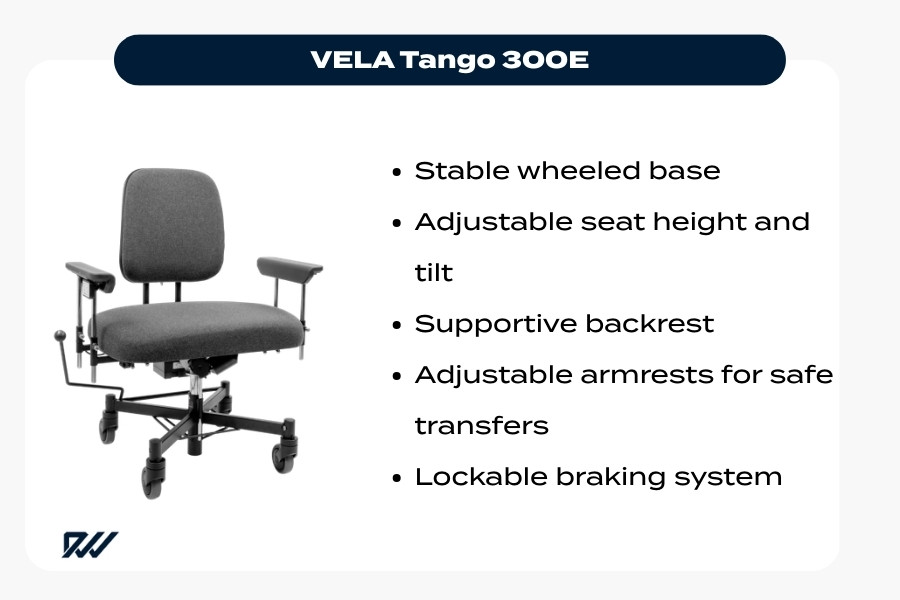
Best for: Clinical and rehabilitation environments requiring stable, supportive seating
The Tango 300E is designed to provide exceptional stability while still allowing ergonomic adjustability. It is particularly suited to healthcare, therapy rooms, and users with reduced mobility.
Key Features
- Stable wheeled base
- Adjustable seat height and tilt
- Supportive backrest
- Adjustable armrests for safe transfers
- Lockable braking system
Why It Works
The braking and stability system prevents unintended movement, making it safer for users who need assistance sitting or standing. At the same time, it maintains ergonomic support for prolonged seated tasks.
Ideal For
- Healthcare environments
- Therapy rooms
- Assisted living settings
- Users requiring additional seated stability
VELA Tango 700E
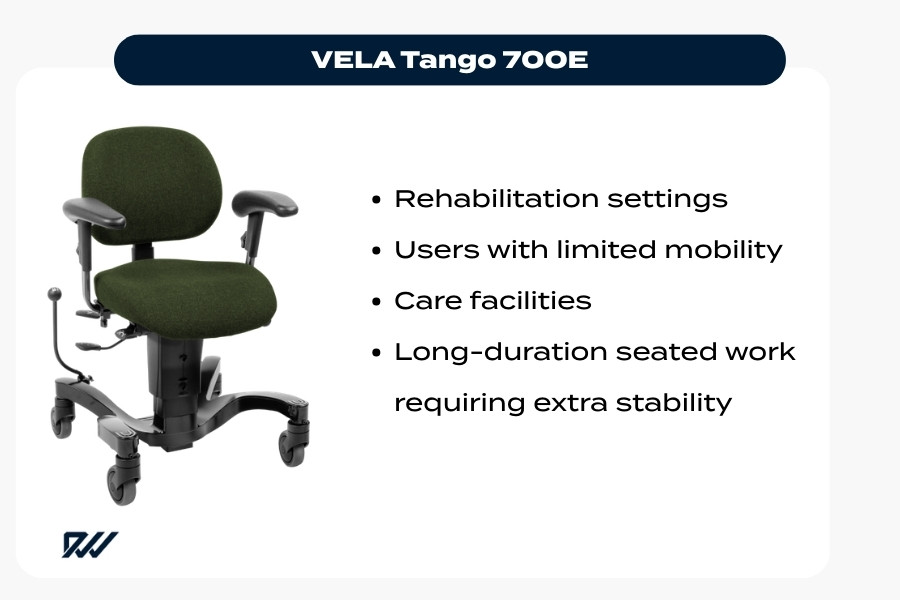
Best for: Enhanced support with greater adjustability
The Tango 700E expands on the 300E with increased ergonomic configuration and mobility support.
Key Features
- Advanced braking and stability
- Adjustable seat and backrest
- Strong supportive armrests
- Designed for safer transfers
Why It Works
It balances comfort with safety, offering both ergonomic positioning and movement control. This makes it suitable for users who need additional reassurance when repositioning or moving within a space.
Ideal For
- Rehabilitation settings
- Users with limited mobility
- Care facilities
- Long-duration seated work requiring extra stability
VELA Tango 700E – Power wheels
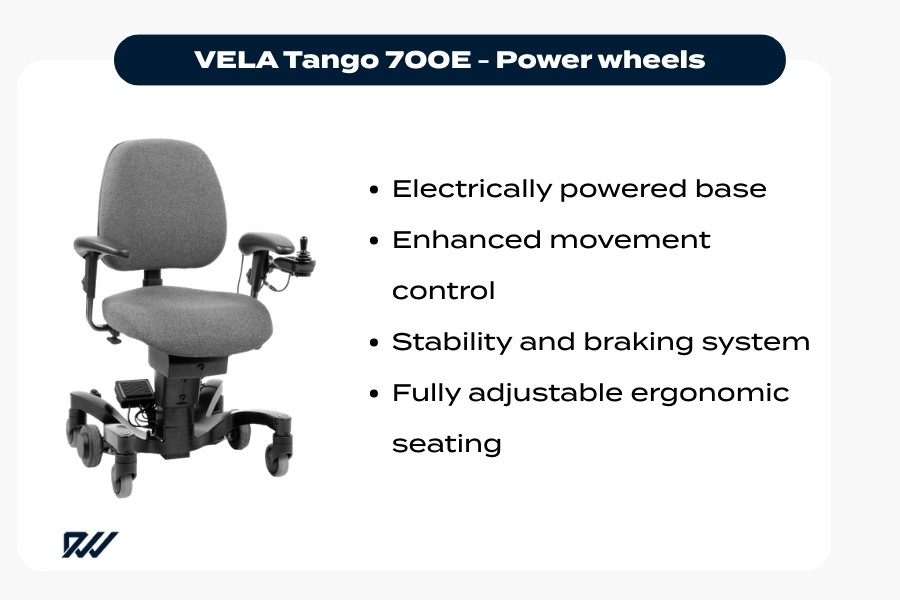
Best for: Users requiring powered mobility assistance
The Power Wheels version adds electrically powered mobility to the Tango 700E platform.
Key Features
- Electrically powered base
- Enhanced movement control
- Stability and braking system
- Fully adjustable ergonomic seating
Why It Works
For users who cannot easily self-propel or reposition manually, powered mobility significantly increases independence while maintaining ergonomic support.
Ideal For
- Assisted mobility users
- Clinical environments
- Specialist care settings
- Long-term seated use with movement assistance
When to Choose a Specialist Chair
A specialist ergonomic chair is appropriate if:
✔ The user requires stability while transferring in and out of the chair
✔ Safety mechanisms are essential
✔ Mobility assistance is needed
✔ The chair is used in healthcare or therapeutic environments
✔ Long-term seated comfort must be paired with movement control
These chairs are not simply “office chairs with extra features” — they are purpose-built solutions for environments where ergonomics and safety must work together.
Quick Decision Guide
- Stable, adjustable clinical seating? → VELA Tango 300E
- More advanced ergonomic configuration and support? → VELA Tango 700E
- Need powered movement assistance? → VELA Tango 700E – Power Wheels
Next, we’ll move into one of the most conversion-focused sections of this guide:
Which Ergonomic Chair Is Right for You?
Now that we’ve explored the full range — from everyday office seating to premium task chairs, saddle designs, big & tall models, and specialist mobility chairs — let’s simplify the decision.
Below, you’ll find recommendations based on real-world user needs, not just price or brand.
Best for Home Offices
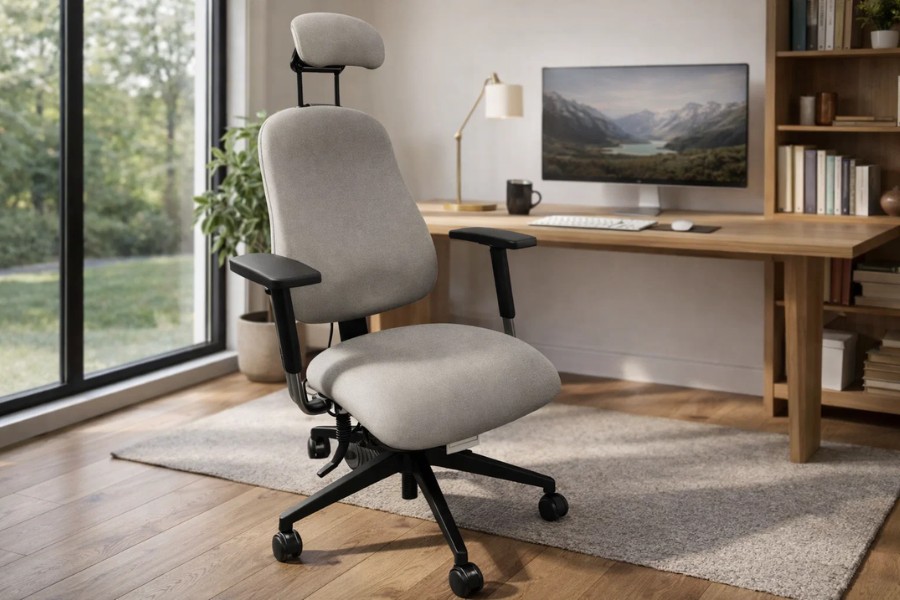
If you work from home full-time or several days per week, you need reliable support without necessarily stepping into specialist pricing.
Strong options:
- Ergochair Zenki Plus – Excellent balance of comfort and value
- RS74 Ergonomic Office Chair – Practical adjustability at a sensible price
- Ergochair Intui- Bondai – Entry-level ergonomic upgrade
If you’re working 8+ hours daily, consider stepping into the Adapt or premium category for long-term comfort.
Best for 8+ Hour Workdays
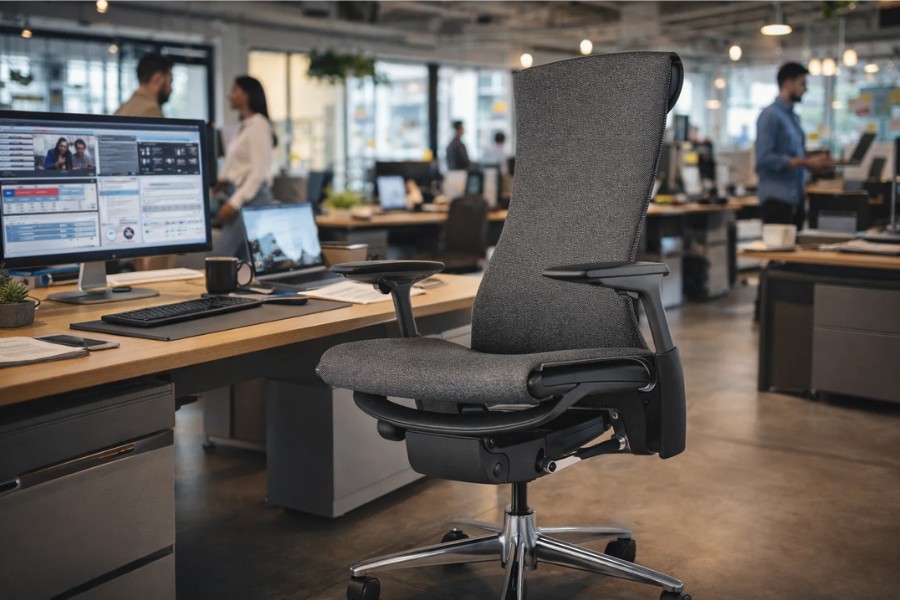
Full-time professionals should prioritise advanced adjustability and dynamic movement.
Top choices:
- Herman Miller Aeron – Breathable mesh and proven long-term performance
- Herman Miller Embody – Advanced back support and pressure distribution
- RH Logic 220 High Back Office Chair – Strong posture-focused design
- Ergochair Adapt 680 Series – High customisation at a lower premium tier
These chairs are built for sustained comfort and support over long durations.
Best for Back Pain Support
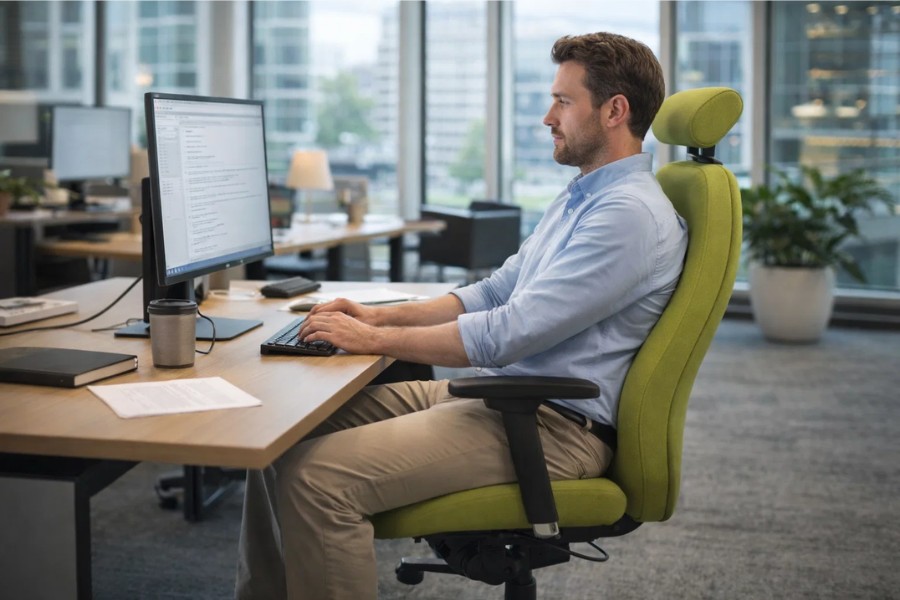
If lower back discomfort is your main concern, prioritise:
- Adjustable lumbar height and depth
- Seat depth control
- Synchronous tilt movement
Recommended models:
These provide refined lumbar positioning and dynamic support to reduce spinal strain.
Best for Big & Tall Users
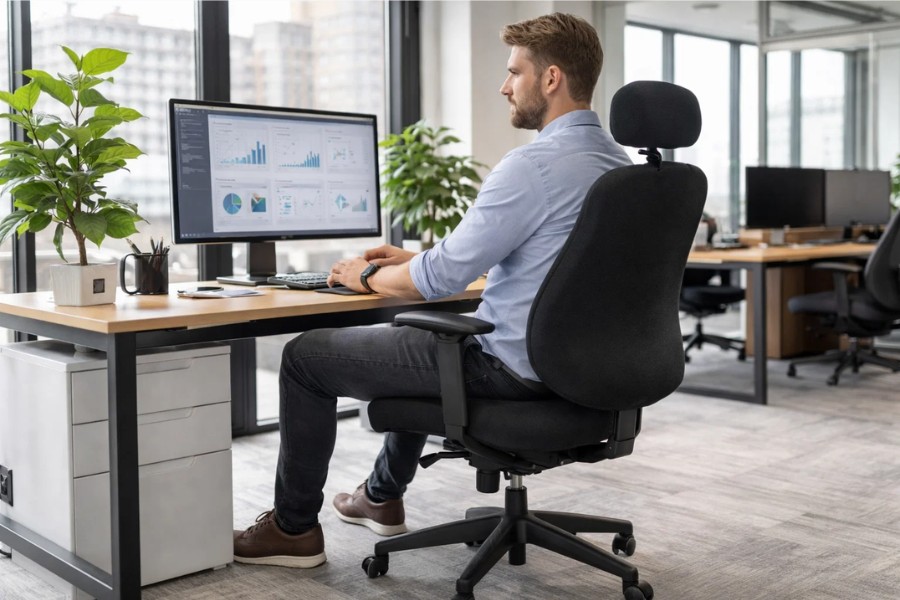
If standard chairs feel narrow or under-supported, choose a reinforced design.
Primary recommendation:
This model is specifically engineered for larger frames and higher weight capacities.
Taller users with average builds may also consider high-back models such as:
Best for Sit-Stand Desks & Active Sitting
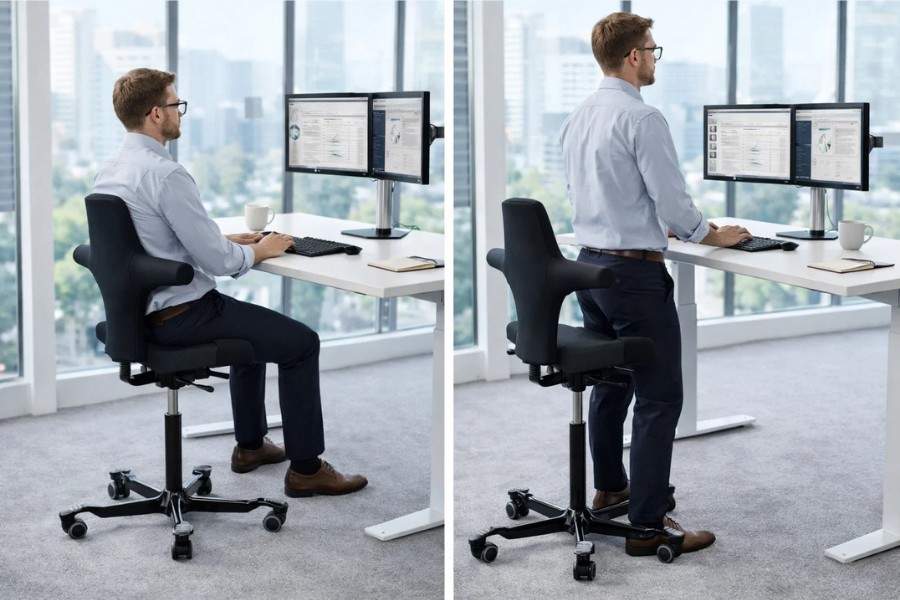
If you regularly alternate between sitting and standing, or prefer upright posture:
- HÅG Capisco 8106-0001– Premium saddle seating
- HÅG Capisco Puls 8010-0003 – Entry-level active sitting
These designs encourage movement and reduce static posture.
Best Premium Investment
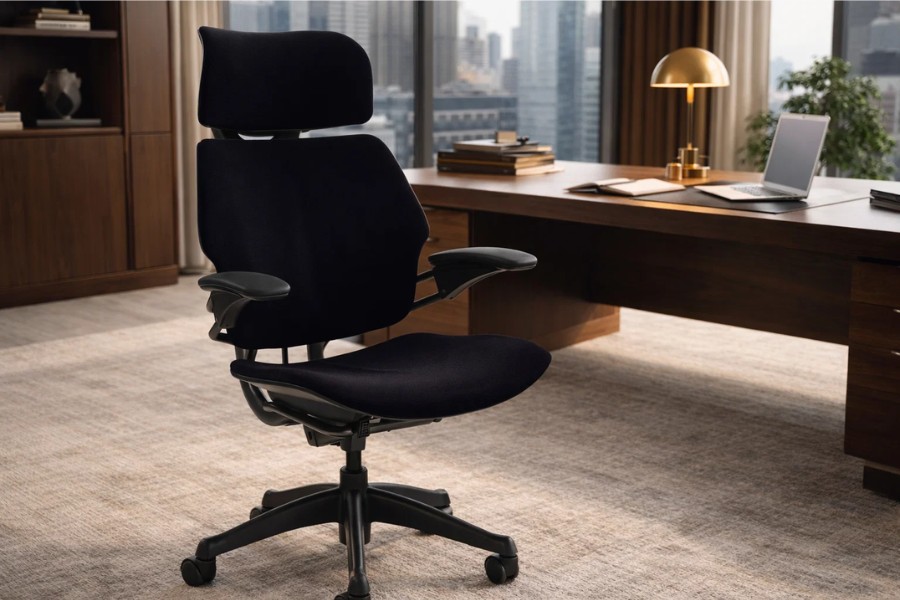
If budget is secondary to performance and long-term health, focus on engineering and refinement.
Top-tier options:
- Herman Miller Embody
- Herman Miller Aeron
- Humanscale Freedom task with headrest
- RH Logic 220 High Back Office Chair
These models are designed for durability, movement, and sustained comfort over many years.
Best for Clinical or Assisted Mobility Needs
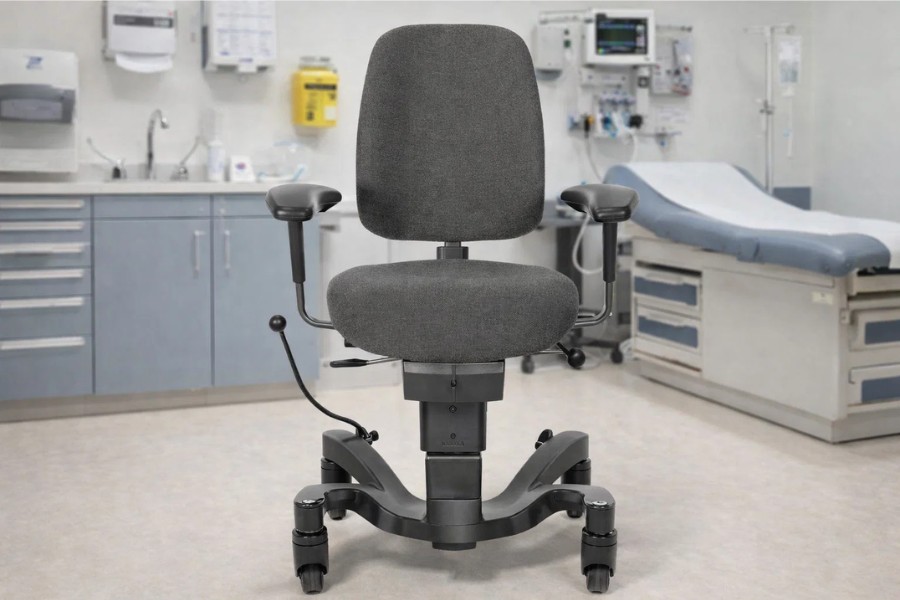
If stability and safe transfers are critical:
These chairs combine ergonomic positioning with safety-focused design and assisted movement.
Final Decision Framework
If you’re still unsure, ask yourself:
-
How many hours per day will you sit?
-
Decide whether you need advanced lumbar and seat depth adjustment.
-
Consider whether your setup is general office use or specialist.
-
Choose between reclined comfort and upright active posture.
-
Think of it as a short-term purchase or long-term investment.
Your answers will narrow the field significantly.
Next, we’ll complete the guide with:
Frequently Asked Questions About Ergonomic Chairs
This section answers the most common questions buyers have before investing in ergonomic seating. Including FAQs not only helps readers make confident decisions — it also improves search visibility for long-tail queries.
What is the best ergonomic chair for long hours?
The best chair for long hours offers:
- Seat depth adjustment
- Adjustable lumbar support
- Synchronous tilt movement
- Durable cushioning or breathable mesh
- Optional headrest support
For extended daily use (8+ hours), premium or highly adjustable models are typically worth the investment. Examples include the Herman Miller Aeron, Herman Miller Embody, RH Logic 220 High Back Office Chair, and the Ergochair Adapt 680 Series.
The key isn’t the brand — it’s whether the chair fits your body and supports movement throughout the day.
Are expensive ergonomic chairs worth it?
Often, yes — if you sit for long periods.
Higher-priced ergonomic chairs typically offer:
- Greater adjustability range
- More refined tilt and recline mechanisms
- Higher build quality and longevity
- Better long-term comfort
If you work at a desk 40+ hours per week, spreading the cost over years of daily use often makes a premium chair a sensible long-term investment.
However, for moderate use, mid-range models like the Ergochair Zenki Plus or RS74 Ergonomic Office Chair may provide everything you need.
What’s the difference between mesh and upholstered chairs?
Mesh chairs (such as the Herman Miller Aeron):
- Provide airflow
- Feel firmer
- Distribute weight evenly
- Stay cooler in warm environments
Upholstered chairs (such as the RH Logic 200 Medium Back Office Chair or Ergochair Adapt 660 Series):
- Offer cushioned comfort
- Often feel softer
- May provide a more traditional seated feel
Neither is objectively better — it depends on personal preference and environment.
Do I need a headrest?
A headrest is helpful if:
- You recline frequently
- You experience neck tension
- You sit for long continuous periods
Chairs like the Humanscale Freedom task with headrest integrate dynamic head support that moves with you.
If you tend to sit upright and rarely recline, a headrest may not be essential.
How long should an ergonomic chair last?
A high-quality ergonomic chair should last:
- 5–7 years (mid-range models)
- 8–15+ years (premium professional models)
Durability depends on:
- Usage hours
- User weight
- Mechanism quality
- Maintenance
Premium chairs are engineered for longevity — which is one reason they command higher prices.
Can an ergonomic chair fix back pain?
An ergonomic chair can significantly reduce strain and improve posture — but it isn’t a cure-all.
For best results:
- Adjust the chair correctly
- Ensure proper desk and monitor height
- Take regular movement breaks
- Maintain good sitting habits
A well-fitted chair supports your body — but healthy movement and workstation setup matter just as much.
Final Thoughts
Choosing the right ergonomic chair isn’t about buying the most expensive model — it’s about selecting the chair that fits your body, your work habits, and your environment.
Whether you need:
- Everyday office comfort
- Premium long-hour performance
- Big & tall reinforcement
- Active saddle seating
- Or specialist mobility support
There is a solution designed specifically for your needs.
If you’re unsure which model is right for you, consider speaking with an ergonomic specialist or requesting personalised guidance before making your final decision.